


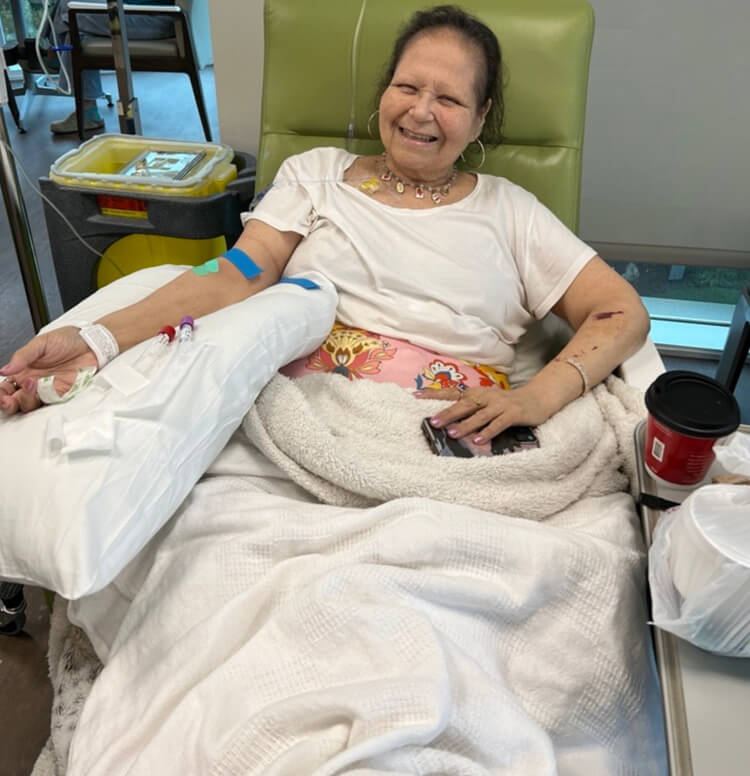
Patricia Almaraz’s life had been great.
She had three jobs she enjoyed, parents and siblings she loved and felt blessed until she heard the three words anyone would dread: “You have cancer.”
At 54, she started having hip pain, was tripping and falling and began losing weight rapidly.
“I was [thinking], ‘What is going on? … Maybe this is menopause,’” she said.
One night, the pain in her hip and tail bone was so bad, she went to the emergency room. Initially, it was thought that she had arthritis.
In January 2019, her hip and tailbone pain worsened and felt like it was creeping up her spine, so she went to the UT Health San Antonio Imaging Center to get an X-ray.
“After [the provider] read the X-ray, she looked at me and she looked worried,” Almaraz said, adding that she informed Almaraz she needed to go to the hospital and offered to call an ambulance.
Almaraz said she could go herself and went across the street to the hospital, where she received a CT scan, X-ray and MRI. She was later informed that she had terminal, but treatable cancer.
Almaraz latched onto the word “treatable” after hearing her diagnosis and pressed on with fortitude.
Leaving a calling
Before she was diagnosed, Almaraz was a teacher, a server at a restaurant and enjoyed tending to a local resident’s yard.
For the past 25 years, her greatest joy had been teaching infants and 2-year-olds at a local child development center.
Though she didn’t have children of her own, she felt like a second parent to her students.
“[Teaching them] was absolutely the greatest thing,” Almaraz said.
Ultimately, her illness forced her to step away from her jobs, but leaving her role as teacher affected her most deeply.
“I couldn’t even dance with [the children] anymore,” Almaraz said, adding it was hard to do the simplest tasks.
Entering a new reality, activating her superpower
Only a month after Almaraz learned she had cancer, her father died.
Almaraz wanted to spare him the worry before his passing and didn’t mention her condition to him.
“I … remember going back to my father’s grave after we had the service, and I kind of looked at his coffin,” Almaraz recalled. “I said, ‘Dad, I’m not coming with you. I’m not coming with you. I have to watch over Mama and [my siblings]. I’m not done yet. … I love you.’”
After additional testing, it was determined that Almaraz had stage 4 endometrial cancer. This meant the cancer that had started in her uterus and endometrium had spread outside the pelvis.
“I had lesions on my bone where the cancer was set because it was sitting on [the] outer part of my uterus and resting on the pelvic bone, so there were lesions in there,” Almaraz said.
Almaraz decided she was going to fight the cancer tooth and nail and called on her self-professed superpower — her stubbornness — for strength. She told herself, “I don’t accept it. Cancer doesn’t belong to my name.” And she believed it with all her heart.
Not only did she battle the illness with everything she had, Almaraz found the time to inspire others through a support group called Purple Heals. The group was started years ago for women with all gynecologic cancers, their caregivers and cancer survivors in San Antonio. It provides a safe and supportive space for members to connect, share experiences and talk about issues they are encountering.
Before the COVID-19 pandemic, the group met in person each month. Today, the group meets digitally via a Facebook page.
Clinical trial provides better quality of life
After she was diagnosed, Almaraz underwent treatments including chemotherapy, radiation to various disease sites, immune checkpoint therapy to help the body recognize and destroy cancer cells, and a targeted therapy combination designed to block abnormal pathways that allow cancer cells to grow and survive.
In June 2025, Almaraz was referred to Daruka Mahadevan, MD, PhD, professor of medicine, director of the Institute for Drug Development (IDD) and associate director of clinical research at UT Health San Antonio’s Mays Cancer Center, to see if there was an appropriate clinical trial for Almaraz.
“The patients who are referred to me are patients who have exhausted previous treatments, and they’re looking for a clinical trial,” Mahadevan said. “And the trials I have here with new drugs are generally first-in-human phase 1 trials, which is the expertise of our IDD program here.”
Mahadevan conducted molecular profiling on Almaraz, taking a sample from her tumor to sequence its DNA and determine what is driving the tumor. A liquid biopsy, or blood test, was also performed to detect circulating DNA from cancer cells in the bloodstream. The testing determined that there were no drugs available specifically for the genetic mutations identified on Almaraz’s tumor.
Based on the eligibility criteria, Almaraz qualified to go on a clinical trial to treat advanced cancers. The investigational agent used in the trial is a potent chemotherapy drug attached to an antibody targeting PTK-7 known as an antibody drug conjugate, a class of cancer treatment that combines a precision cancer therapy by targeting a specific protein (PTK-7) expressed on tumor cells with the cancer-killing power of chemotherapy.
Almaraz started the trial in November 2025. At first, she did fairly well on the drug and the tumors shrank a bit. At one point, however, she had a setback and was hospitalized. After the hospitalization, she was in rehabilitation for several weeks and returned to taking the investigational agent on a lower dose, which has helped alleviate much of the pain she had been feeling in her bones.
“[Patricia] has done remarkably well,” Mahadevan said. [Her cancer] continues to have a response to this drug and she has a good quality of life now.”
Caring for the whole patient
As director of the Institute for Drug Development at Mays Cancer Center, Mahadevan said he believes that research is the key to progress.
“Our job as oncologists and physician-scientists is to really find the Achilles’ heel for these [cancer] tumors,” he said, adding that it’s a game of chess between the tumor, drug and the body.
And while research is essential, when treating patients, Mahadevan looks at the whole person.
“I want to know everything about the patient, whether there’s depression, anxiety, nutritional issues, hydration, all of those things are very important for patient care, not just the tumor and the drug.”
Mahadevan is so involved in his trials, he provides his cell phone number to patients to call at any time.
Cancer couldn’t break her spirit
As Almaraz continues her clinical trial treatment and looks to the future, she wishes the best for her nieces and nephews.
“I would love to watch my nieces and nephews grow up succeeding in their life and having their own families,” Almaraz said.
Mahadevan commended Almaraz for her strong resolve.
“I think Patricia is a lady who is determined to live,” Mahadevan said. “She wants to live with a good quality of life. And the drug that she’s on is helping her to do that. And my job is to make sure that her overall health is in good shape and her performance status will allow her to continue without any new toxicities. The IDD phase 1 team of nurses, including Vanessa Collazo, RN, have made a big impact in managing Patricia’s care. Patricia has done really well and that inspires me.”
To learn more about cancer care or research and clinical trials at Mays Cancer Center, call 210-450-1000.