



At 75, Frank Morrill, a retired attorney, leads an active life filled with dance, yoga and time with his grandchildren. But in 2024, a knee injury began to limit the mobility he depended on.
“I had had issues in that knee for a while, but when I injured it further, it felt different. There was a persistent looseness in the knee,” Morrill said. “I would feel it first thing in the morning. Once it began, it did not go away. That’s when I knew I needed to get it looked at.”
Morrill turned to UT Health San Antonio’s orthopaedic surgeon, Thomas M. DeBerardino, MD, for answers. He learned he wasn’t quite a candidate for a total knee replacement — but doing nothing wasn’t an option either. Instead, DeBerardino recommended a new option: the MISHA knee system, an implant designed to relieve pressure on the inside of the knee.
The device was recently approved by the U.S. Food and Drug Administration (FDA) as the first implantable shock absorber for people with early-stage knee osteoarthritis. UT Health San Antonio is among a limited number of sites participating in a nationwide clinical trial of the MISHA knee system, helping to expand access to the latest procedures in orthopaedic innovation and offer the newest options to eligible patients.
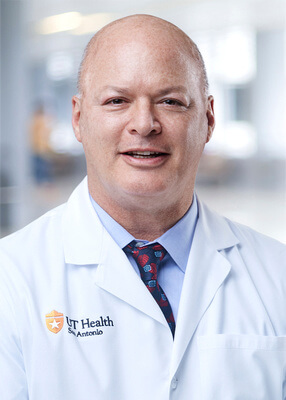
“This is for patients in that gray zone,” DeBerardino explained. “It’s a perfect option when a total knee would be overkill for a patient, but they need something more than conservative treatment. The MISHA device unloads the inside of the knee when you walk, which can relieve pain and improve function.”
Unlike traditional joint replacement, the MISHA implant is placed on the outside of the knee joint, making it less invasive and allowing for quicker recovery. More importantly, it can help preserve mobility for years, delaying or even avoiding the need for a total knee replacement.
“It guarantees you don’t need a total knee replacement right now,” DeBerardino said. “If we can push that surgery 10 or 15 years down the road, or eliminate it altogether, that’s a big win for patients.”
For Morrill, the possibility of maintaining his active lifestyle made the decision clear. He underwent the procedure in August 2024 and saw immediate results.
“I was back up on the knee right after surgery. Almost immediately I got strength where I didn’t have strength before. That looseness was gone,” Morrill said. “The next day for the follow up, I was on my crutches walking out of the building. Just for fun, I pretended like I was falling. Dr. D. and the nurse jumped, but then I looked up and laughed. So, that was the day after surgery, and I felt good enough to joke about it.”
Today, Morrill is back to the activities he loves.
“Essentially, I’ve got my knee back,” he said. “I can dance, do yoga and chase after my grandkids again.”
For patients like Morrill, the MISHA knee system offers something new: a way to stay active while putting off, or potentially avoiding, major joint replacement in the future.
“The technology is really amazing,” Morrill said. “It gives you something that wasn’t available before.”
Patients interested in learning whether they may be candidates for the MISHA knee implant can call UT Health San Antonio Orthopaedics at 210-450-9300 for more information.