


Teaming with UF, UCSF and VCU to improve detection, bring hope
The Glenn Biggs Institute for Alzheimer’s and Neurodegenerative Diseases at UT Health San Antonio, the academic health center of The University of Texas at San Antonio, has received a competitive $2.5 million award to launch and lead a national, multi-site study focused on improving detection and diagnosis of dementia with Lewy bodies.
Discovered by German neurologist Dr. Friedrich Heinrich Lewy in 1912, Lewy bodies are abnormal, microscopic clumps of protein called alpha-synuclein that build up inside the brain’s nerve cells. They disrupt essential brain chemicals causing nerve cells to die, leading to progressive, widespread decline in brain function.
Historically, abnormal alpha-synuclein only could be confirmed after death, limiting early diagnosis. While new tests have been designed to detect this protein during life, there still are critical gaps in understanding how early these changes can be identified and how well they align with symptoms and other disease markers, including Alzheimer’s-related proteins.
The study, called Clin-Syn and funded by the Lewy Body Dementia Association, aims to address those gaps by evaluating these emerging diagnostics across real-world patient populations. Lewy body dementia is second only to Alzheimer’s as the most common neurodegenerative cause of dementia and there is no cure, with treatment currently focused on managing symptoms and improving quality of life.
A current barrier to testing new disease modifying treatments is accurately identifying individuals who have accumulated abnormal alpha-synuclein in the brain. Clin-Syn aims to evaluate multiple possible new tools and methods to do so.
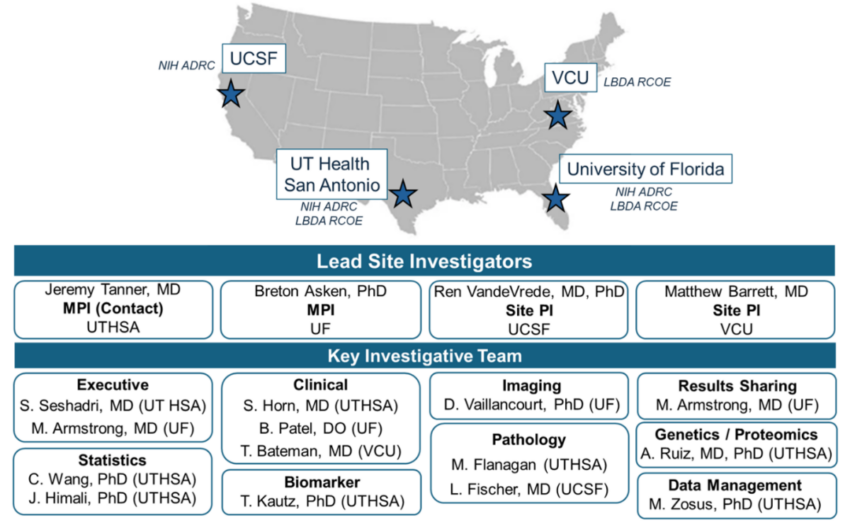
The new effort aligns with ongoing activities at the UT Health San Antonio Lewy Body Dementia Association Research Center of Excellence and the National Institutes of Health-funded South Texas Alzheimer’s Disease Research Center, and is in collaboration nationally with other expert research centers at the University of Florida, University of California San Francisco and Virginia Commonwealth University.
The study will enroll 50 people with early symptoms of dementia with Lewy bodies, 50 people with early symptoms of Alzheimer’s disease and 25 adults without symptoms.

Participants will complete a single comprehensive visit that includes a neurological exam, cognitive tests, brain scans, skin and blood sample collection, a lumbar puncture, saliva collection, and optional stool samples and brain donation enrollment.
“By analyzing multiple biomarkers of alpha-synuclein and Alzheimer’s disease in these samples, and linking them with clinical symptoms, we aim to better understand what each test reveals about brain changes in dementia with Lewy bodies and Alzheimer’s disease to help inform clinical practice and clinical trials,” said Jeremy Tanner, MD, assistant professor of neurology at the Biggs Institute and a principal investigator, UT Health San Antonio lead site investigator and contact for Clin-Syn.
He said they also will ask participants about their experiences and preferences regarding testing, so that the researchers can develop best practices for clinicians and trials to share results in clear and meaningful ways.
While Alzheimer’s primarily affects memory, language and thinking, Lewy body dementia is marked by early movement symptoms like tremors, vivid hallucinations, dream enactment behavior and unpredictable daily fluctuations in alertness.
Tanner said the new study, fully titled, “Clin-Syn: Validation of Multimodal α-Synuclein Biomarkers and Repository for People with Dementia with Lewy Bodies and Alzheimer’s Disease,” is a strong example of cross-institution collaboration.
“We want to both accelerate diagnostic biomarker research in Lewy body dementia and provide clinicians with a clearer understanding of what these biomarker tests mean for their patients so that they can most effectively and meaningfully communicate results and guide management decisions,” said Breton Asken, PhD, also a Clin-Syn principal investigator and lead site investigator at the University of Florida. “This project will help doctors use these tests more effectively to diagnose and care for patients.”
“It will also create an open-access, high-quality resource of biological samples and data to accelerate the development and testing of treatments that slow or stop the disease,” said Ren VandeVrede, MD, PhD, site principal investigator at the University of California San Francisco.
High-profile individuals impacted by Lewy body dementia have included Robin Williams, Estelle Getty, Glen Campbell, Casey Kasem, Tom Seaver, Charles Schulz, Jerry Sloan and, more recently, media mogul Ted Turner and legendary Texas singer-songwriter Joe Ely.
“Our efforts will help transform how we diagnose and eventually treat those affected by dementia with Lewy bodies,” said Matthew Barrett, MD, site principal investigator, vice chair for translational research and professor of neurology at Virginia Commonwealth University. “This collaboration will influence the field and ultimately improve care for patients and families affected by this devastating disease.”
Tanner and Sarah Horn, MD, clinical assistant professor of neurology, co-lead the UT Health San Antonio Lewy Body Dementia Association Research Center of Excellence. Okeanis Vaou, clinical associate professor and chief of the Movement Disorders Division at UT Health San Antonio, is the site lead for another study called PRISMS on a sleep marker for Lewy body dementia.
Each year, the Biggs Institute hosts the “Dr. George D. Case Memorial Lecture” on Lewy body dementia that draws national leaders in the field. The event is named for a prominent San Antonio urologist who had the disease and was cared for at UT Health San Antonio.