


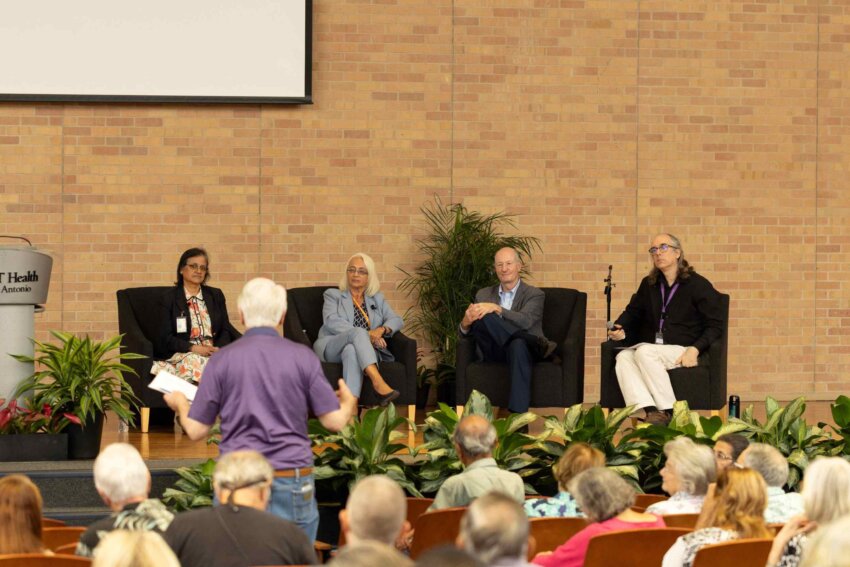
Three leading experts in neurology and aging gathered at UT Health San Antonio Sept. 22 for Texas Public Radio’s Think Science event to share the latest in brain health research.
Event host Nathan Cone noted that Alzheimer’s disease affects about 460,000 Texans, with another 1.1 million serving as caregivers. Programs at the Health Science Center provide hope that scientific advances may one day make Alzheimer’s a disease of the past.
Preserving brain health
Sudha Seshadri, MD, DM, tenured professor and founding director of the Glenn Biggs Institute for Alzheimer’s and Neurodegenerative Diseases, outlined risk factors for dementia and emerging treatments. Brain health, she said, is more than the absence of disease — it’s about memory, emotional control and the ability to keep living the life a person wants to live.
“The best way to preserve brain health when you grow older is to not wait until you’re 60 or 80, but start the day you’re born,” she said.
Seshadri explained that most dementia cases involve a combination of factors. New blood tests and imaging tools are revealing those factors, and treatment may require a “cocktail” of drugs, similar to cancer care. Recently approved intravenous medications lecanemab and donanemab help some patients in early disease stages. Injectable versions became available in August, and another drug, trontinemab, which is still in clinical trials, may be up to 50 times more effective at removing amyloid plaque, with fewer side effects.
Seshadri emphasized the importance of comprehensive care. The new Center for Brain Health, she said, will bring together cutting-edge therapies, clinical programs and research all in one five-story building.
“We hope this will help us increase the number of doctors, nurses and researchers to provide care in a timely manner and find answers more quickly — because we need answers yesterday,” Seshadri said.
Geroscience and aging
Elena Volpi, MD, PhD, FGSA, professor in the Division of Geriatrics, Gerontology and Palliative Medicine, Department of Medicine, and director of the Sam and Ann Barshop Institute for Longevity and Aging Studies, described the institute’s efforts to understand the link between aging biology and diseases such as dementia, heart disease and Type 2 diabetes. She said aging research, or geroscience, is still young, but that growing evidence shows interventions that target the biology of aging may help delay or prevent many conditions at once.
Recent projects have included studies of metformin, a Type 2 diabetes drug that appears to reduce dementia risk, and senolytic drugs such as dasatinib plus the supplement quercetin, which may clear harmful “zombie” cells that accumulate with age. The Health Science Center has also discovered longevity benefits of rapamycin through the National Institutes of Health National Institute on Aging’s Interventions Testing Program. That drug is now being tested for effects on cognition.
Other studies are investigating drugs that reduce oxidative damage, improve metabolism or even repurpose HIV antivirals for cognitive impairment. Volpi said these efforts build on a new understanding that many diseases of aging share common roots.
“I’m an optimist by nature, and I think that based on the scientific evidence we are currently accumulating, we will soon be able to start recommending specific geroscience-based interventions that can extend health span and cognition, particularly in our clinical population,” she said.
Advances in stroke and neuromuscular care
Matthew Wicklund, MD, FAAN, professor in the Department of Neurology and director of the Muscular Dystrophy Association Multidisciplinary Care Center, turned the focus to stroke, Parkinson’s disease, and neuromuscular disorders. Stroke remains the fourth leading cause of death in the U.S., but Wicklund said the Health Science Center has played a national role in advancing treatment.
The institution helped pioneer the use of clot-busting drugs like tenecteplase, extended the treatment window for thrombectomy to 24 hours, and contributed to new approaches for hemorrhagic stroke. Its clinical trials have influenced prevention, telemedicine expansion, and post-stroke rehabilitation.
“For stroke outcomes, it’s not just what happens at the time, but what happens after,” Wicklund said.
In Parkinson’s disease, the Health Science Center was one of only six national “super sites” for a major genetics study. Wicklund said the team also contributed to trials leading to Food and Drug Administration approval of subcutaneous levodopa-carbidopa therapy in 2024 and was among the first to test adaptive deep brain stimulation and focused ultrasound for tremor control.
Progress in neuromuscular disease, he added, is accelerating after decades of delay. Since 2016, more than 20 gene-based therapies have become available, including a transformative treatment for spinal muscular atrophy.
“We now have children who are four, six, eight years old, walking, breathing, eating, and roughly equivalent to their peers,” he said.
While some novel therapies, such as micro-dystrophin for Duchenne muscular dystrophy, have been less dramatic, Wicklund said gene replacement and RNA-based strategies are entering a new era.
Precision medicine and prevention
During a question-and-answer session with the audience, panelists emphasized how precision medicine, such as PET scans, spinal fluid analysis, and sensitive blood tests are guiding more individualized treatment.
“The idea of precision medicine is that each person who has memory problems is not the same as every other person,” Seshadri said.
Prevention and lifestyle modifications, panelists said, remain equally important to maintaining brain health.
“It’s never too late to start exercising,” Volpi added, noting benefits for cognition and cardiovascular health.
Looking ahead
Seshadri said that UT Health San Antonio, the clinical enterprise of The University of Texas at San Antonio, is now in the process of applying for a five-year renewal of the NIH-funded Alzheimer’s Disease Research Center at the Health Science Center. The conversation also pointed to a statewide opportunity in November for Texans to vote on dedicating funding for dementia research and care, modeled after the state’s cancer initiative.
“This is very similar to the cancer initiative that transformed research in our state,” Seshadri said. “We now have a chance to do the same for dementia.”