


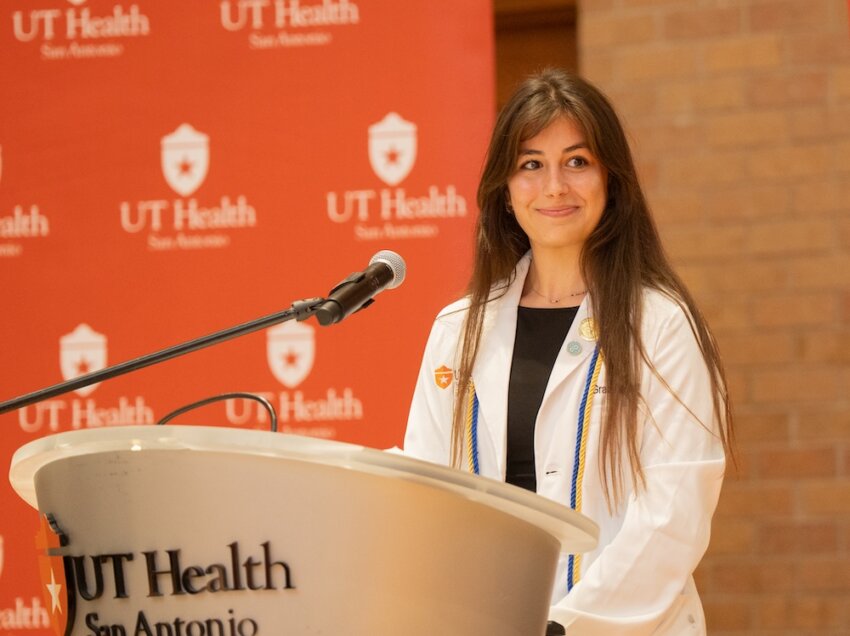
Grace McGuire decided to become an occupational therapist after witnessing a child’s joy when he successfully signed his name for the first time.
“It was just a huge celebration and accomplishment for him,” recalled McGuire, president of the Doctor of Occupational Therapy Class of 2026 in the School of Health Professions.
McGuire had been volunteering at a clinic when she observed the handwriting breakthrough. Although she had been focused on physical therapy as her likely path, her curiosity about occupational therapy was piqued, and she asked the boy’s occupational therapist why she had chosen the profession.
“She told me now this kid is going to be able to sign their homework, take ownership of that, sign a check in the future, sign a thank you card,” McGuire recalled. “So, this one task where they gain this independence carries over to these really big moments where they get to show their identity, take ownership and participate.”
“Once I heard that, I was sold. I thought, ‘That’s amazing.’ And I knew that’s what I wanted to do.”
A heart for pediatrics
McGuire, a 2024 Presidential Ambassador Scholar, chose the OTD program at UT San Antonio in part because of its emphasis on community and service.
“We go into healthcare to serve people, and they really took that component and integrated it into our program curriculum,” she said.
Although she initially thought she would choose to work with adults, McGuire’s experience in the program has inspired her to work with children in either an outpatient or school setting. In fact, her capstone project this spring focused on helping students navigate what can be a challenging environment: the elementary school lunchroom.
Helping children find calm in the cafeteria
McGuire implemented an established program called “Comfortable Cafeteria,” part of a larger mental health initiative called “Every Moment Counts,” at an elementary school serving 620 students from kindergarten through fifth grade. During the program, students engaged in a variety of weekly lessons and activities designed to help them develop social skills, including mealtime conversation, nonverbal communication and how to be inclusive, as well as learn about healthy eating choices.
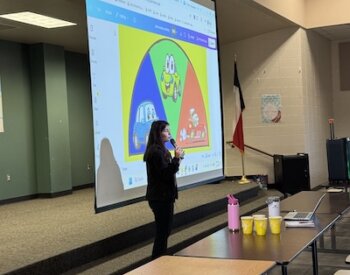
Before launching the program, McGuire noticed how hard lunchtime can be for children trying to squeeze in eating and socializing in a short amount of time. The program included resources for teachers, which McGuire adapted for the kindergarten, first- and second-graders. She also met weekly with each grade level to review lessons and engage in activities such as conversation starter bingo and introduced popular sensory-friendly interventions such as dimmed lights, calm music and a relaxing aquarium video. By the end of the program, McGuire observed the students putting the lessons into practice, and students, lunch supervisors and teachers connecting in a positive way.
“The program created a more positive experience for both staff and students,” she said.
“There are a lot of social skills and self-regulation skills for the students,” she said. “We really need these skills in order to participate, talk to our friends successfully, ask the teacher if we need something that we forgot in the lunch line or be able to handle a stimulating environment like the cafeteria. These are skills they can take and use to perform successfully in their school routine.”
“It makes the cafeteria a more comfortable place for everybody,” McGuire said, explaining that occupational therapy has a place in the lunchroom and just about anywhere. “Occupational therapy really is in every part of life.”
Going through the occupational therapy program, from the classroom through clinical rotations and finally her capstone experience, has given McGuire an appreciation for the profession and its possibilities.
“I think I’ve fallen in love with how flexible a profession we have and how creative we’re allowed to be,” she said. “I think the relationships we build as OTs are so important in the therapy process.”
“Hosting this program has been a huge thing to pull off,” she added. “Maybe a year ago, I wouldn’t have known I could do it, but I’m doing it now, which is so exciting to see the growth for myself. It’s really opened my eyes to wherever I land next, finding that need and knowing I can create a program to fill it.”