The UT Health San Antonio Blood Donor Center recently hosted its first blood drive since opening earlier this summer — and to great success.
Thanks to dozens of students and staff members who answered the call to donate blood during the Dec. 4 blood drive at the Health Science Center campus, the center collected 24 units of blood, four more than the goal of 20 units, said Joni Granados, supervisor of at the Blood Donor Center and the Blood Bank at the UT Health San Antonio Multispecialty and Research Hospital.
“The turnout was truly heartwarming,” Granados said. “Seeing so many students and staff come together to donate shows the incredible spirit of our community. Every unit collected will directly help patients at our hospital and Mays Cancer Center, and we’re so grateful for everyone who made this possible.”
Planning for the big event
Hospital Transfusion Manager Bettina Villarreal and Granados began planning for the blood drive more than two months ago, carefully coordinating the date, location and safe transport of equipment, supplies and blood products.
The phlebotomy team — Vanessa Muniz, Sabrina Morales and Brianna Trinidad — played a critical role in ensuring all necessary supplies were ready for the day of the drive. After the event, they worked diligently to process and separate whole blood units within the required timelines.
Meanwhile, Villareal and Granados reviewed all collection data to confirm compliance with U.S. Food and Drug Administration and accreditation standards for documentation, testing and turnaround times.
And their extensive planning paid off.
Phlebotomist Vanessa Muniz said she was pleasantly surprised with the number of donors who came to the blood drive, adding that each of their contributions makes a difference.
“There are traumatic accidents and traumatic surgeries that need red cells … this is great for our blood supply,” Muniz said.
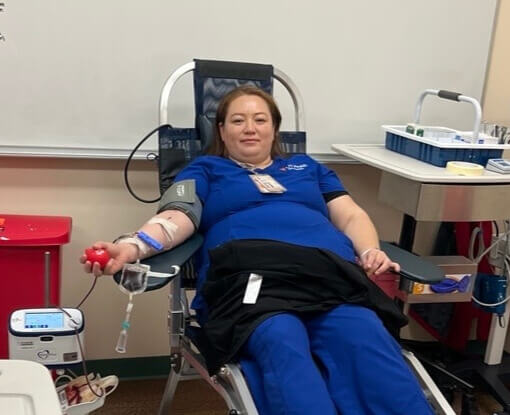
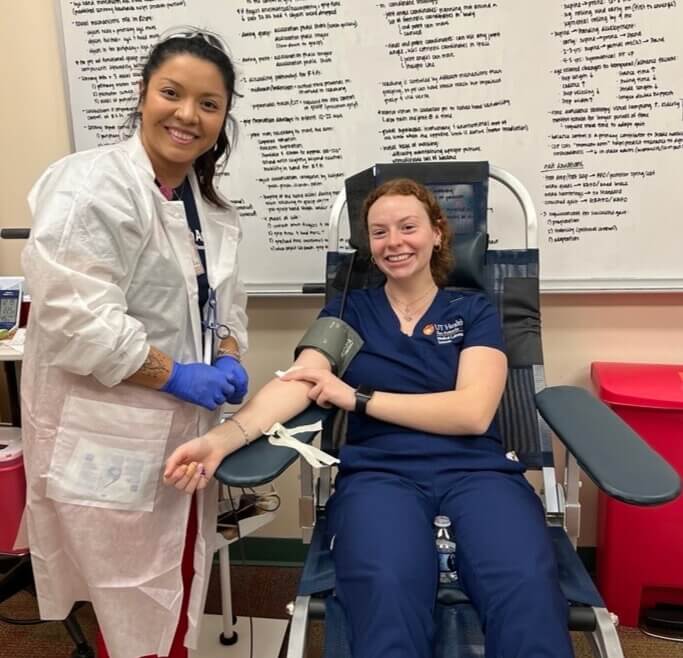
During the four-hour event, 41 students and staff streamed into the Dolph Briscoe Jr. Library’s second floor to donate. Each person was there for different reasons, but they all had one thing in common: they wanted to perform the life-saving act of donating blood.
Jacqueline Limon, senior medical assistant at the Medical Arts and Research Center, knows the importance of blood donations, having had a family member who got sick and needed a transfusion.
“I’m doing this just in case somebody needs blood,” Limon said.
Carly Sturdevant, a first-year student in the Medical Laboratory Sciences program, said she was excited to participate in the on-campus opportunity to donate blood.
“I know a lot of people can’t donate just because of different health conditions, and so I think it’s important that the people who are healthy can get out there and donate to help save lives,” Sturdevant said.
Sturdevant had donated blood at the same time as Kendra Miller, a Dental Hygiene student who was also more than happy to donate during her lunch break.
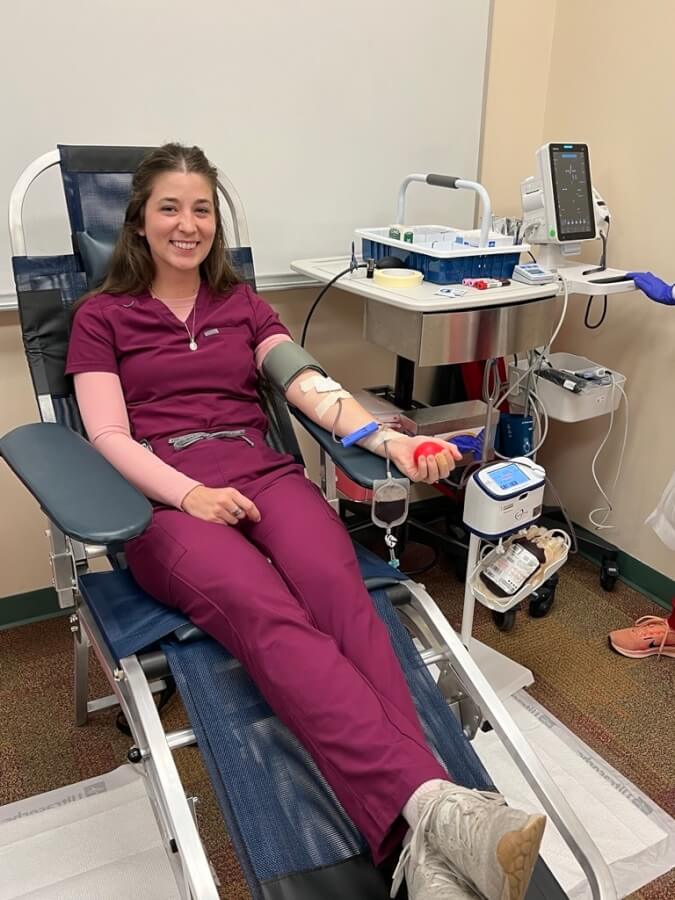
“I think it’s important because there are people who need blood,” Miller said. “It’s a 15-minute donation, and it could potentially save somebody.”
Villareal said she very pleased with the synchronized precision her team displayed throughout the event.
“I am incredibly proud of what our team accomplished and know their hard work will directly benefit our patients at UT Health San Antonio — and I’m excited to see what we achieve next,” Villareal said, adding that she and Granados plan to explore additional blood drives at The University of Texas at San Antonio’s Health Science Center and academic campus locations.
Hospital Blood Donor Center helps save lives
Every two seconds, someone in the United States needs blood, according to the National Heart, Lung and Blood Institute.
For Granados, every blood donation is a gift that helps patients at the hospital and Mays Cancer Center.
“Blood donations are critical for countless patients, especially those undergoing intense medical treatments,” Granados said. “For oncology patients, transfusions of blood and platelets are often life-sustaining, counteracting the effects of treatments like chemotherapy that deplete healthy blood cells. Similarly, patients undergoing complex orthopedic surgeries frequently require blood to replace what is lost during procedures, ensuring stability and enabling recovery. The generosity of blood donors directly supports these vital medical interventions, making life-saving care possible.”
Working in both the Blood Donor Center — which collects blood — and the Blood Bank next door — which stores the donated blood and performs testing to determine blood compatibility for patients — Granados is in a unique position to meet both the blood donors and blood donation recipients.
“It’s really nice that I get to see the entire process and get to know these donors and get to know people that they’re saving as well,” Granados said.
One donation is equivalent to 1 pint or unit of blood and can be given to up to two patients, Granados said.
While all blood donations are needed, the O-negative, O-positive whole blood donations and A and AB blood types for platelet donations, are in high demand, Granados said.
“We reserve O-negative blood for women of childbearing age,” Granados said. “When they have an emergency, we will give O-negative blood. But any female who is not of childbearing age or any males, can also receive O-positive red blood cells, so type O is really helpful for red blood cells.”
Only about 7% of the population has O-negative blood and about 38% of the population has O-positive blood, the most common blood type, according to the American Red Cross.
The donation of platelets — especially from those with the A or AB blood type — is also critical, Granados said, adding that patients having a bone marrow transplant require more platelets and red blood cells. Platelets also have a shorter shelf life than the 42-day shelf life for blood donations. After the platelets are drawn from donors during a 2.5-hour process, they undergo bacteria testing and then have a short shelf life of five days, Granados said.
“The A or AB blood type is really helpful for platelets because those can be given to most patients,” Granados said. “For platelets, typically if we have an AB whole blood donor, we’ll try to convert them to do platelets because AB red blood cells can only go to AB patients.”
Less than 1% of the U.S. population has the AB-negative blood type, making it the least common blood type among Americans. Patients with the AB negative blood type can receive red blood cells from all negative blood types, according to the American Red Cross.
How to donate
To donate blood or platelets, call 210-562-8230. Appointments are encouraged, but walk-ins are always welcome. The Blood Donor Center is open Monday–Friday, from 9 a.m. to 4 p.m. with the last donations made at 2 p.m.
Looking ahead, the Blood Donor Center is hoping to hold quarterly blood drives on the Health Science Center campus, Granados said, adding that she cannot overstate the importance of each donation.
“You don’t realize how much your blood is needed until you know somebody who needs it,” Granados said. “We are issuing lots of blood to our patients, especially in our surgical suite. So just the act of giving, even if your blood can’t be given to your relative, we can use that to give to somebody else and we can use somebody else’s to give to your relative. It just helps … to make sure that we have enough on hand for all our patients.”