


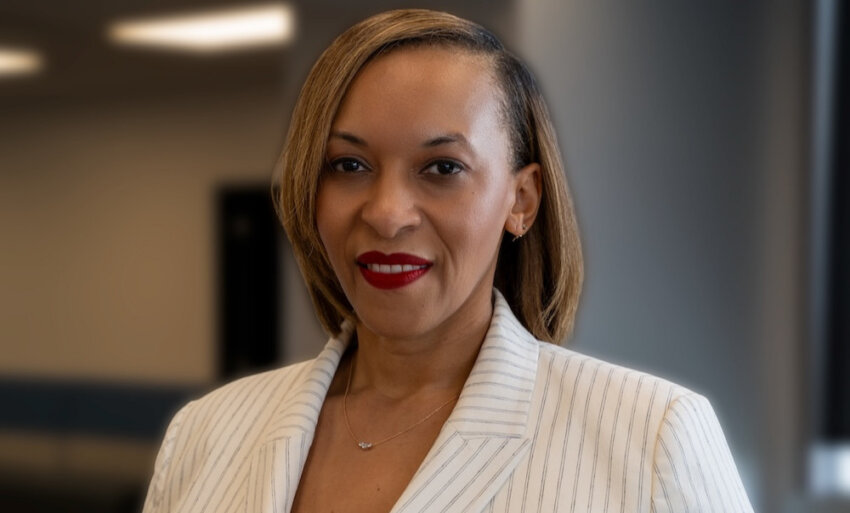
As a nurse, Laquonda Finney, RN, wanted to make a difference on an even larger scale.
“I didn’t want to stop at nursing,” Finney said. “I liked the idea of not being confined to a space, where I can go out within the community to see what those needs are and to try to address those needs.”
Finney researched graduate-level public health programs to pursue her goal. At first, she was uncertain if an in-person program would align with her busy schedule, but a productive discussion helped solidify her decision.
Finney met with William Garner, DrPH, MPH, associate professor in the Department of Health Policy and Health Services Administration at The University of Texas at San Antonio’s Kate Marmion School of Public Health.
“I assured Laquonda that with the right supports from her family and together with the institution, we were prepared to make this a good experience for her, a meaningful experience,” Garner said.
A first-generation college student on her mother’s side, Finney decided to move ahead with the in-person program and in August 2024, joined the inaugural Master of Public Health cohort of 35 students at the Kate Marmion School of Public Health.
And she’s glad she did.
“I feel like in the classroom setting, especially with public health and bouncing off ideas with my cohort you get that lived experience from everyone,” Finney said.
Turning research into real-world impact
Through the program’s applied practice experience — a practical learning opportunity where students apply knowledge gained in the classroom to real-world settings — Finney has embarked on a research study with The Institute for Public Health and Education Research to explore the perceived barriers to seeking depression treatment for residents in Comal County. The study aims to address a critical gap in mental health services.
Finney’s work on this study draws on her public health education and her wealth of experience as both an HIV program coordinator ensuring that patients adhere to their treatment plans and as a nurse with a trauma-informed care background, which emphasizes safety and empowerment while avoiding re-traumatization.
“As an MPH student, this lens has shaped how I approach research and population-led interventions, ensuring the data and interventions remain rooted in dignity, equity, cultural context and lived experience,” Finney said. “I see trauma-informed care as a bridge between clinical practice and public health — connecting individual healing with community healing.”
Recognizing her dedication to improving health outcomes in communities that need it most, Finney’s project received a $500 research grant from the South Central Area Health Education, a nonprofit organization dedicated to clinical training opportunities for healthcare practitioners to better address the needs of medically underserved communities.
Finney and her research team are now entering the recruitment phase of the study. Once the participants are identified, data will be collected and analyzed, and the findings will be submitted to a peer-reviewed public health or mental health journal and shared with community stakeholders to help inform practice and policy, Finney said.
“Ultimately, the goal for the findings is to support community-responsive mental health outreach strategies and help local organizations and providers to tailor services in ways that are more accessible to residents,” Finney said.
A distinctive bond among classmates
Being among the school’s inaugural MPH cohort has been a special experience, Finney said.
“All of us lean on one another,” she said. “All of us have our person in the group that we lean on a little bit more. I know I do.”
It helped a great deal that the professors were also very supportive, Finney said.
“The professors respond quickly to our emails,” she said. “They answer any questions. Our classes are in the evening, and I’m sure at the end of the day, when class is over, they’re ready to go home. But they’re always willing to stay behind and discuss things with us.”
A future filled with possibilities
During the past year and a half, Finney faced some personal adversities, but stayed the course with the MPH program, remaining optimistic as she looks to a future with many possibilities. Among those is the potential pursuit of a doctorate in public health.
But before taking that next step, she plans to take some time to focus on her family.
“This pause is important to me as a way to reflect, recharge and remain grounded in the values that drive my nursing and public health work,” Finney said.
Seeing Finney move forward with intention and added clarity has been rewarding for Garner as an educator.
“The Laquonda that I know today is definitely clearer about what she wants her contribution in public health to be,” Garner said. “I believe she trusts her voice in ways that she may not have known before because she took this risk for herself to pursue a Master of Public Health through an in-person program. And I think that’s so beautiful, that she was willing to do that and that she feels like we kept our promise to her in terms of being able to support her through her education. I think that’s really important.”
When the time is right, Finney is confident that she will take her next steps with purpose and intention.
“There’s a lot I can do with this degree, especially as a nurse,” Finney said. “I can cross over anywhere.”