



For Shiva Kazempour, a graduating PhD student in the Graduate School of Biomedical Sciences, the journey into biomedical research began not in a lab, but in the world of mathematics.
Originally from Tehran, Iran, she completed her undergraduate and master’s degrees in computational statistics and biostatistics, respectively, building a strong foundation in computational skills. But over time, she found herself wanting more meaningful work than abstract equations.
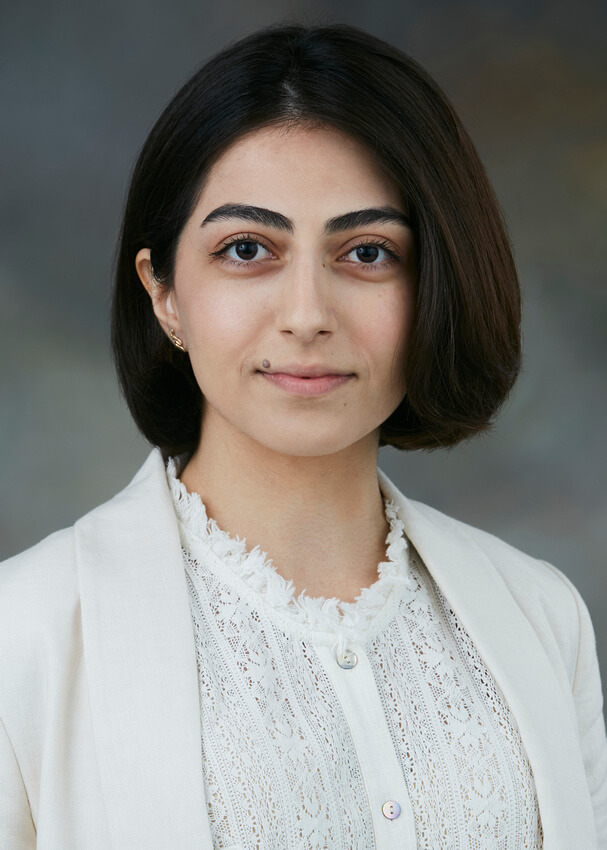
“I wanted to move beyond rigid mathematical work and have a real impact,” she said.
From computation to care-focused research
That desire led her to UT San Antonio’s Health Science Center, where she spent two years working as a research scientist. There, she applied her computational skills to a range of diseases, gaining firsthand experience in how data-driven approaches can inform biomedical research.
Still, she recognized a gap in her training.
“I knew the mathematics and computational work, but I wanted to gain more biological knowledge and add it to my toolbox,” she said.
Encouraged by her mentor, she pursued a PhD from the Integrated Biomedical Sciences program at the Graduate School of Biomedical Sciences, which would ultimately allow her to bridge both worlds.
Targeting “zombie cells” in neurological disease
Kazempour’s research focused on senescent cells in the brain, often referred to as “zombie cells.” Unlike healthy cells, these cells stop dividing but are not cleared from the body. Instead, they release inflammatory signals that can damage surrounding tissue and contribute to neurodegenerative diseases such as Alzheimer’s, ALS and Parkinson’s.
“One of the biggest challenges is that we don’t have specific biomarkers to identify these cells,” she said.
To address that challenge, Kazempour developed computational pipelines capable of identifying senescent cells using large-scale datasets. Working with collaborators, she then helped validate those findings in the lab, translating computational discovery into biological insight.
The implications of this work are significant. By identifying these cells more precisely, researchers may be able to develop earlier diagnostic tools and patients can receive targeted therapies sooner for their complex neurological diseases.
Continuing translational research
Kazempour is now continuing her research in a new role. After completing her coursework in December 2025, she began her position as a senior bioinformatician at Washington University in St. Louis in March, where she focuses on spatial transcriptomics, an emerging field that maps gene expression within tissues to better understand disease at a cellular level.
“I don’t want my work to remain on a computer,” she said. “I want to see it make a difference.”
Leadership, innovation and entrepreneurship
That commitment to translation extends beyond the lab. During her time at UT San Antonio, Kazempour was deeply involved in student leadership and innovation initiatives. She served as president of the Graduate School International Club and later co-founded the San Antonio chapter of Nucleate, a program that helps students explore how their research can be developed into startups.
Through that work, she helped create new pathways for students to think beyond academia and consider how their ideas might translate into real-world solutions.
She is now putting that philosophy into practice as co-founder of VirVa Health, a startup focused on women’s health that she established along with another graduating PhD student from the graduate school, Virgil Bideau, who studies endometriosis and women’s reproductive health.
“It’s a lot of work, but I think the whole community at UT San Antonio was always so supportive of the students exploring different avenues,” she said. “And I think without that we probably wouldn’t have risked doing it. So that supportive environment is really impactful.”
Recognition, community and looking ahead
Kazempour’s accomplishments during her PhD include publishing a first-author paper in Nature Aging during her first year and earning departmental recognition for academic excellence over three consecutive years.
Beyond the accolades, she emphasizes the importance of community, especially as an international student navigating a new environment.
“There were times when classmates reached out to support me in ways I didn’t expect,” she said. “That sense of community really stayed with me.”
As she looks ahead, Kazempour remains focused on the same goal that first brought her to biomedical science: making a meaningful impact.
Click here for more information about the Class of 2026 commencement ceremonies.