


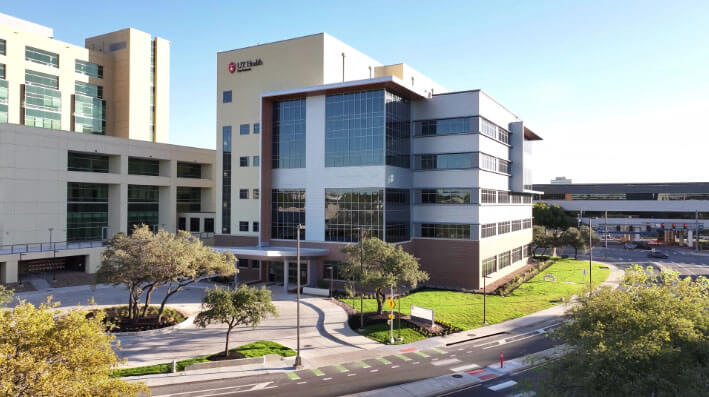
The opening of UT Health San Antonio’s Center for Brain Health marks a step forward for families affected by amyotrophic lateral sclerosis (ALS), frontotemporal dementia (FTD) and other rare neurodegenerative diseases.
Understanding ALS
ALS is a degenerative disease of nerves called motor neurons, which are in the brain and spinal cord. It is most commonly diagnosed in individuals between ages 50 and 60, but cases have been reported in teenagers as well as individuals in their 90s. The disease is relatively rare, with an incidence of only two to five cases per 100,000 people. Approximately 30,000 people in the United States live with ALS.
“I’ve seen firsthand how the disease can overwhelm caregivers. The logistics of helping a loved one with mobility, nutrition, daily hygiene and multiple medical appointments can feel worse than the disease itself. We wanted to create a center that could support the whole family, not just the patient,” said Carlayne Jackson, MD, FAAN, chair of the Department of Neurology and professor of neurology and otolaryngology at the Joe R. and Teresa Lozano Long School of Medicine at The University of Texas at San Antonio.
About 90% of ALS cases are sporadic, with no identifiable cause, while roughly 10% are genetic. Most genetic forms are caused by dominant mutations, which can affect multiple family members across generations. Symptoms often begin in the hands, arms or legs leading to tripping, weakness and difficulty with everyday tasks like opening a jar or turning a key. Speech muscles can also be affected. The disease progresses over time, ultimately leading to respiratory failure or pneumonia.
Despite decades of research, effective treatments remain limited. Medications like riluzole and edaravone slow progression, but no therapies currently stop the disease, and average life expectancy is two to five years after diagnosis.
ALS, FTD connection and genetics
A. Campbell Sullivan, PsyD, ABPP-CN, associate clinical professor with the Division of Neuropsychology in the Department of Neurology at the Long School of Medicine and with the Glenn Biggs Institute for Alzheimer’s and Neurodegenerative Diseases, has spent her career studying rare and early-onset neurological conditions, including ALS and FTD.
Frontotemporal dementia often strikes before age 60 and affects behavior rather than memory, leading to challenges in diagnosis and treatment. Sullivan’s research has focused on genetic connections between FTD and ALS, including the C9ORF72 and TARDBP genetic mutations.
“For some families, understanding the genetic link can provide clarity,” Sullivan said. “In my own family, we’ve seen the impact of ALS-FTD across generations. Having a diagnosis allowed us to test other family members and plan for the future. That’s what we hope to provide for all families — answers, guidance and support.”

National collaboration and early intervention
The Center for Brain Health will participate in national research initiatives such as ALLFTD, which tracks patients and at-risk gene carriers to understand disease progression. Jackson said early identification is crucial in these diseases.
“Once symptoms appear, patients have already lost a significant portion of motor neurons. Our goal is to identify and intervene as early as possible. That’s where precision medicine and early-phase clinical trials come into play,” Jackson said.
Clinical research at the new Center for Brain Health will focus on clinical trials and biomarker identification to find ways to provide earlier detection and treatment of these rare diseases. The Center for Brain Health is part of an ongoing national ALS study that collects genetic and biomarker data, while monitoring participants’ functional abilities, strength and disease progression. It is also participating in the HEALY ALS Platform Trial, conducted in collaboration with Massachusetts General Hospital and more than 40 other national centers, which is evaluating seven different drugs for ALS under the same protocol, allowing for faster and more efficient clinical trials. Unlike traditional studies with 50/50 placebo distribution, 75% of participants in this study received active treatment, making enrollment more appealing for patients seeking new therapies.
Education, support and community
The Center for Brain Health offers a model for the future of neurological care, combining advanced research, multidisciplinary clinical care and family-centered support to address some of the most challenging neurodegenerative diseases.
Beyond research, the Center for Brain Health emphasizes education, family support and community connection. Patients and caregivers have access to telemedicine and virtual programs, allowing families across Texas to participate even if they cannot travel. Support groups, caregiver education and resources on navigating medical information are integral parts of the Center for Brain Health’s holistic approach.
“This is about building a community,” Jackson said. “These families are dealing with rare, devastating diseases in the prime of their lives. We want them to know they are not alone. We provide tools, support and hope and we do it in a way that respects the patient and the family.”
Looking ahead
Early research into new drugs, such as tofersen for genetic forms of ALS, has been promising, and ongoing efforts to understand the mechanisms of both genetic and sporadic neurodegenerative diseases may spur development of new therapies in the coming years.
“We’re starting to find therapies that can slow disease progression. The next step is stopping it altogether,” Sullivan said. “Ten years from now, I believe we’ll have that breakthrough.”
For now, Sullivan finds inspiration in both the families she serves and the next generation of scientists she mentors.
“Our goal is to support families and help them make the most of the time they have,” she said. “We may not be able to stop the train of disease progression, but we can do everything possible to slow it down with care and compassion.”