



For years, Krischina Sutherland, 73, lived with worsening pain in multiple joints that gradually took away her mobility and independence.
Advanced joint disease and complications from earlier joint surgeries made even basic daily activities difficult. Her knees had already been replaced by other surgeons, and a prior right hip replacement had been redone twice but never fit correctly. As time went by, she needed a wheelchair to get around.
“The wheelchair was awful,” Sutherland said. “I had such trouble just sitting down or getting around the house because I was in so much pain.”
A retired schoolteacher who spent years educating students across the Texas Hill Country and surrounding communities, Sutherland now lives on a ranch with her husband. As her condition worsened, moving around the property, keeping up with daily chores and engaging in her favorite hobbies became nearly impossible.
Former students of hers, including a doctor and a physical therapist, encouraged her to seek another opinion about her hip pain.
Sutherland first met orthopaedic surgeon Frank Buttacavoli, MD, at UT Health San Antonio in 2019 after complications with the replacement in her right hip caused an infection. The hip ball had worked its way into the hip bone, and Buttacavoli performed surgery to remove the damaged joint components and treat the infection.
“When I first saw him, he told me, ‘You’re going to hate me for the next two months, but we’re going to fix this,’” Sutherland said. “Then he gave me a hug and said, ‘I’m going to treat you just like my mother.’ That meant so much to me.”
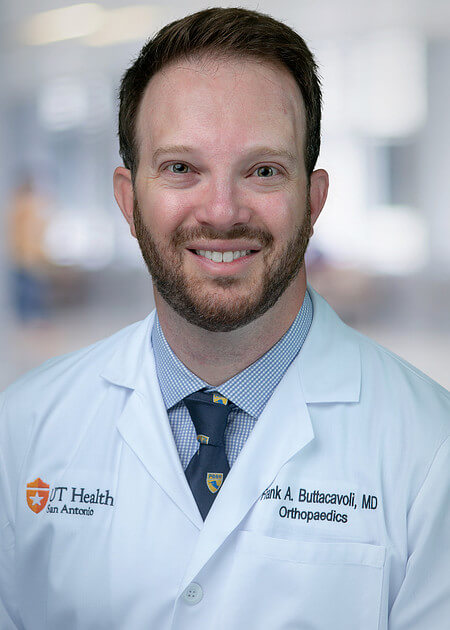
Because multiple severely damaged joints were contributing to her pain and loss of mobility, Buttacavoli developed a staged treatment plan. After removing the infected right hip components, Sutherland spent six weeks in rehabilitation in a wheelchair while receiving antibiotics and follow-up care with an infectious disease specialist.
“We piece everything together by listening to the patient, examining them and using imaging,” Buttacavoli said. “When joint disease progresses to the point that everyday activities become difficult like getting dressed, getting in and out of a car or simply walking, it may be time to consider joint replacement.”
Years later, when severe pain developed in her left hip and leg, Sutherland was initially treated elsewhere and was told the pain was due to issues in her back. She sought physical therapy, but her symptoms only worsened. After she found herself in a wheelchair again and unable to walk, she returned to Buttacavoli, who determined that her left hip required a complete replacement.
Following that surgery, Sutherland spent two nights in the hospital and quickly began regaining mobility.
When she returned home, her family expected she would still need help getting into the house.
“They asked if they needed to get the wheelchair, and I said, ‘Nope, I’m going to walk into the house,’” Sutherland said.
Today, Sutherland is once again able to care for herself, move around independently and return to the ranch chores she enjoys.
And as for her wheelchair?
“I threw that thing in the barn,” she said.
Now, Sutherland said she is grateful to be living with far less pain and far more independence.
“I’m so happy with what we did,” she said. “To be able to walk again is just amazing.”
Now, after years of pain, repeated surgeries and long stretches of uncertainty, Sutherland is able to move through daily life with far greater ease and confidence. Her story reflects not only the physical impact of complex joint disease, but also how surgical expertise, careful planning and thoughtful care can help patients regain function, independence and the routines that matter most.
For more information or to request an appointment or second opinion, please call 210-450-9300 or visit UTHealthcare.org/Ortho.