



New therapeutic also could reduce scar tissue from injury
A new grant could help reduce the amount of opioids needed to treat pain for burn patients by 90% and significantly decrease scar tissue from the wounds that restrict function.
The $451,857 award from the Trauma Research and Combat Casualty Care Collaborative (TRC4), a University of Texas System initiative housed at UT Health San Antonio, could have major implications for two of the greatest clinical needs of both military and civilian burn trauma patients, said Nathan Jeske, PhD, principal investigator of the grant.
Jeske is a professor and director of research with the Department of Oral and Maxillofacial Surgery of the School of Dentistry at UT Health San Antonio, the academic health center of The University of Texas at San Antonio, and with the school’s Center for Pain Therapeutics and Addiction Research. He is joined on the grant with co-principal investigator Candelaria Daniels, PhD, program manager, Combat Wound Care, U.S. Army Institute of Surgical Research.
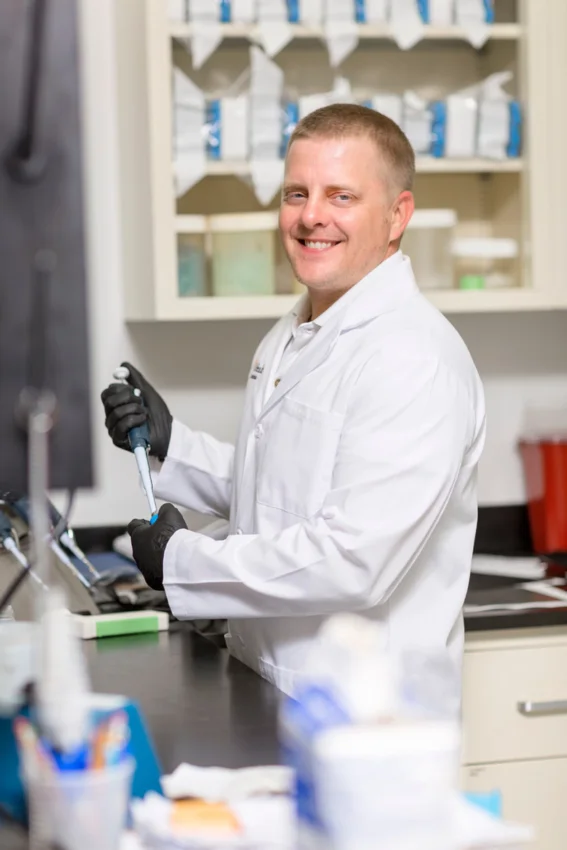
“Burn patients typically receive opioids to manage trauma pain, yet negative side effects associated with opioids have renewed efforts to increase the safety profiles for treatment,” Jeske said. “Tissue repair following burn trauma also represents an important treatment priority, with dermal fibrosis, or scar tissue, often preventing return to full function. We seek to improve burn trauma care in both areas by targeting an important signaling kinase, an enzyme, with a new-generation inhibitor.”
TRC4 was established by the UT System with the stated aim of revolutionizing trauma care for both military and civilian populations by funding innovative research, product development and preventive strategies, aiming to reduce deaths and improve recovery from traumatic injuries. From its headquarters at UT Health San Antonio, it connects UT institutions with the Department of Defense and the Defense Health Agency to tackle critical gaps in trauma medicine.
Thermal burn traumas represent a critical battlefield injury, with more than 25,000 service members sustaining burn trauma in support of post-9/11 operations from 2001 to 2018, according to the grant summary. And civilian burn injuries result in more than 400,000 hospital emergency department visits and approximately 40,000 acute admissions each year.
This represents a significant trauma category in both military and civilian populations that requires acutely managed care to reduce pain and promote functional healing. Treatment is particularly difficult because of a wide range of molecular mechanisms that occur in response to the injuries.
The researchers had discovered that targeting G-protein Receptor Kinase type 2 (GRK2), an enzyme that plays a crucial role in regulating cell signaling, can improve analgesia and reduce tissue fibrosis.
Specifically, their previous work identified GRK2 as playing a key role in controlling the effectiveness of opioid receptors in peripheral sensory neurons, revealing an untapped pharmacological pool of receptors to target for pain relief and reducing the likelihood of negative side effects that limit clinical treatment.
They developed an innovative, new-generation inhibitor, a compound or drug, designed to regulate the activity of GRK2 to improve opioid pain-killing efficacy, thereby reducing the amount of opioids needed. Further, the inhibitor limits production of fibroblast collagen, reducing tissue scarring.
The goal of the grant project is to establish that the inhibitor supports opioid-sparing analgesia and improves tissue repair following trauma.
“We expect our research findings to improve patient recovery from trauma injury by reducing the amount of opioids necessary to provide analgesia and by reducing tissue fibrosis at injury sites,” Jeske said.