


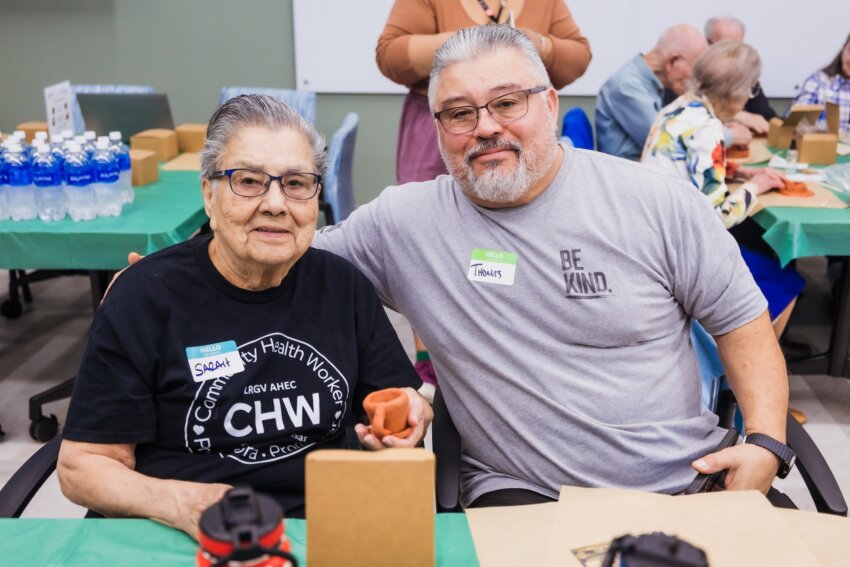
For Thomas Brittain, programs like “ReCollections: Art Conversations to Stimulate the Mind” have given his mother, Sarah Cadena — who suffers from Alzheimer’s disease — a sense of community and belonging.
“I attribute my mother’s longevity to [participating] in [these kinds of] programs,” Brittain said.
The free art program — a collaboration between the Glenn Biggs Institute for Alzheimer’s and Neurodegenerative Diseases at UT Health San Antonio and the San Antonio Museum of Art (SAMA) — brings people with Alzheimer’s disease and related dementias and their caregivers and families together through meaningful conversation, shared memories and hands-on creative experiences.
Brittain and his mother have attended ReCollections since its inception in 2022. On Friday, Jan. 23, the mother and son were among 31 people who attended the first ReCollections event to be held at the new UT Health San Antonio Center for Brain Health.
“She has made friends [at these events],” Brittain said, adding that while it can feel isolating both for those suffering from dementia and for their caregivers, having an arts program that encourages attendees to share memories and stories and experience meaningful social connection has been “a godsend.”
Melissa Flores, LPC, counseling and community programs coordinator at the Biggs Institute and one of the architects of the ReCollections program in San Antonio, said the program empowers families impacted by dementia to engage fully, feel valued and remain active participants in their community.
“Through viewing and creating art, participants may experience activation in the brain associated with attention, visual spatial abilities, and recognition,” Flores said. “The program also incorporates reminiscence, encouraging individuals living with dementia to share memories and stories from their lived experiences. For those who may have difficulty with verbal communication, the hands-on artmaking portion offers an accessible form of creative expression, helping participants feel seen, understood, and valued. Overall, [the program] reduces feelings of isolation and consistently supports improved mood, connection and well-being for those families who attend.”
Conversation + creation = connection
During the event, SAMA AT&T Director of Education Tripp Cardiff welcomed attendees with a warm smile, inviting them to provide observations on pieces of art he would be presenting on two television screens. The objects presented were inspired by one of the museum’s special exhibitions called “Canvas to Clay: Georgia O’Keeffe & Maria Martinez to Mata Ortiz & Tonal.”
“I’m really curious just to hear your observations about the work … and your questions as well,” Cardiff said, adding, “Please do not be shy. That’s where the magic of this program happens.”
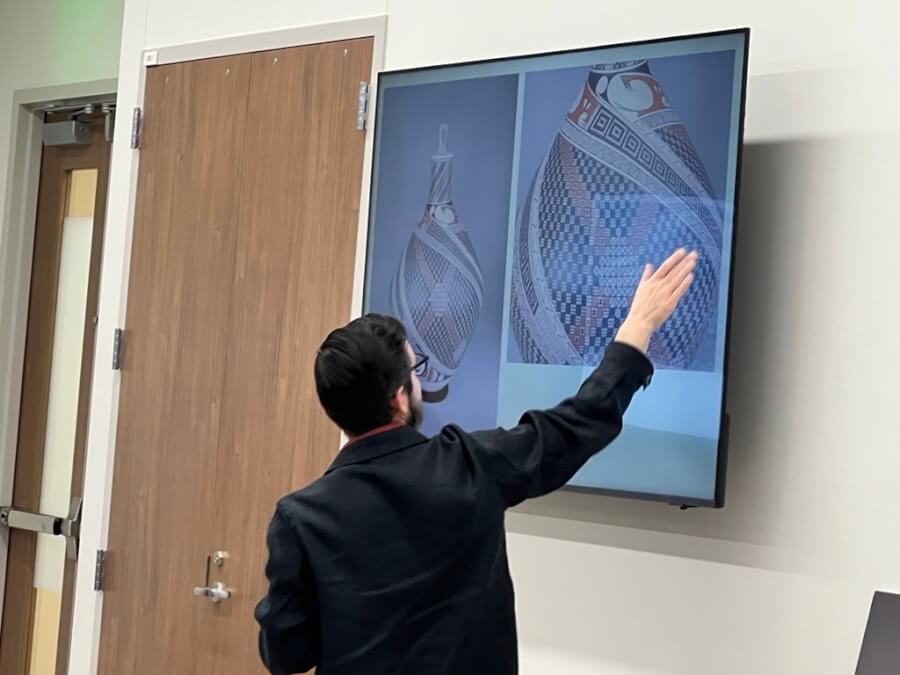
And with that, the first image appeared on the screens. The attendees intently studied a beautiful clay vessel adorned with geometric designs, and soon, the magic happened. Questions from event attendees flowed in quick succession.
“How big is it?”
“How thick is the pottery itself?”
As each question came in, Cardiff naturally wove the conversation in different directions, asking more questions and eliciting more observations.
Later, Cardiff introduced potter Juan Quezada on the screens. The artist grew up in the town of Mata Ortiz in Chihuahua, Mexico.
“As a boy, he would often go into the hills around his village to gather firewood for his family, for cooking and warmth,” Cardiff said. “And as he would do this over time, he started picking up and noticing pottery fragments on the ground in the hills around this town. So, he started collecting them.
“It turns out that these pottery fragments were from a pre-Columbian culture that lived in the area,” Cardiff said, adding that Quezada began experimenting with creating clay vessels without any formal artistic training.
As Quezada’s art-making endeavor became increasingly lucrative, he began sharing his technique with his family, neighbors and community. Soon, the entire town of Mata Ortiz was transformed from an impoverished community in the Chihuahuan desert to one of the major centers of ceramic production in Mexico today, Cardiff said.
With that story, Cardiff pivoted to an engaging question: “What have you learned from someone special in your life?”
Attendees were quick to provide examples of traditions and knowledge handed down from generation to generation — from making cookies to sewing.
After the discussion, attendees were invited to use hand-building techniques with clay. Nia Jaramillo, an artist working at the museum and helping with the ReCollections program, demonstrated techniques to help attendees create their art pieces.
The hand-building techniques are an important way for any adult to engage in the arts, Jarmillo said.
“I think it’s helpful for adults of any age to create, to engage in the arts and music and dance and poetry,” Jarmillo said. “When we are using our hands to make [art], we’re just kind of allowing our brains to be free. It’s healing for the soul.”
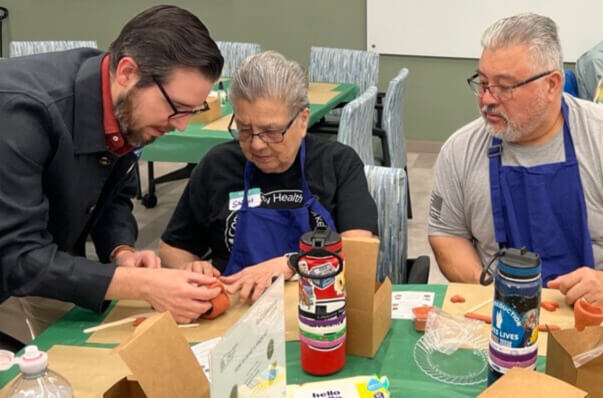
As participants worked diligently to bring their unique visions for their clay masterpieces to life, they reflected on recollections from the past.
Those who may have been too shy to share their observations earlier began to naturally reminisce about their past traditions and upbringing. Some discussed their past experiences with art. One participant shared that she had a professional art degree. Another shared that she was kicked out of art class, but if her teacher could see her now.
How ReCollections was born
Flores had the idea to create the ReCollections program after learning about a similar program at the Museum of Modern Art in New York City. After discussing her idea with the director of the Biggs Institute, she approached the museum about partnering in the program.
“When creating ReCollections, we intentionally addressed the challenges many families may face following a dementia diagnosis: social isolation, low mood and limited community engagement due to stigma or uncertainty about bringing a loved one into public spaces,” Flores said.
When the program was launched in 2022 during the pandemic, it was virtual.
“Once people started feeling comfortable, kind of getting out of their houses and doing things again, we knew that we really wanted to do this in person and have that kind of face-to-face time and to experience the museum and the art up close,” Cardiff said.
The program has become so successful that it is transitioning from quarterly to monthly, Cardiff said, adding that one event will be held at the Center for Brain Health and two events at the museum each quarter.
The ReCollections art program is also extending its impact beyond scheduled events by placing activity kits in the Pam Burdick Art Room at the Center for Brain Health, inviting patients to create while they wait for appointments and to carry the joy of artmaking home.
To learn more or sign up for the ReCollections program, click here.