



Scientists at The University of Texas at San Antonio discovered a potential path to maintaining the cancer-fighting benefits of one type of immunotherapy while limiting harmful organ damage, providing new hope for this promising treatment.
Immunotherapy is a powerful tool in cancer treatment, but its power can come at the cost of severe side effects like liver toxicity.
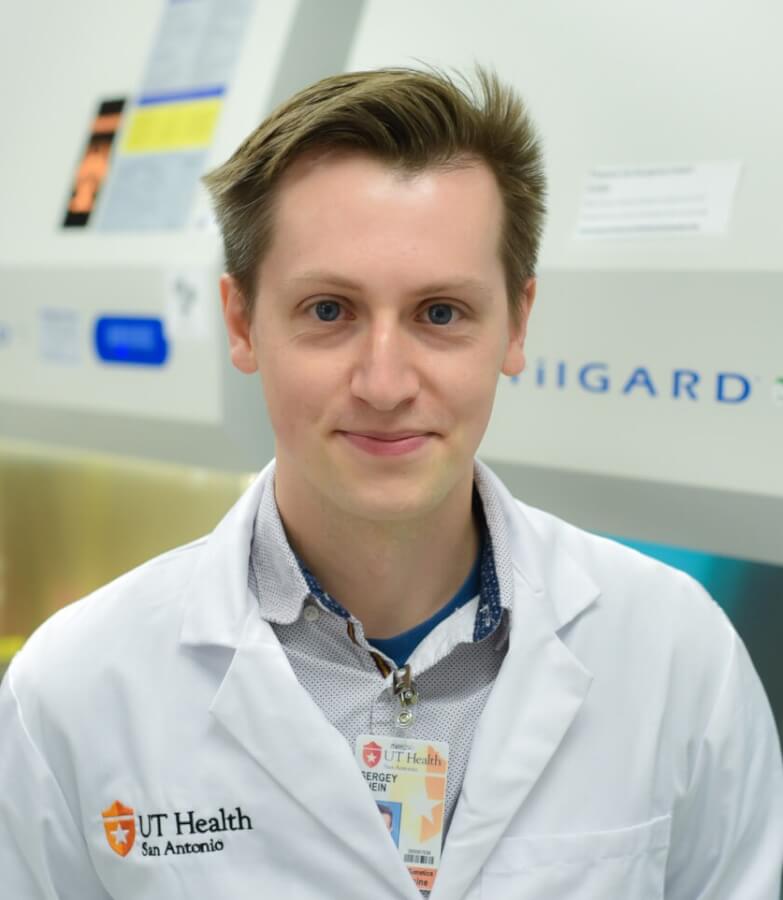
The study, funded through a Cancer Prevention and Research Institute of Texas award, was published April 22 in Science Advances. Leading the investigation was Sergey A. Shein, PhD, research instructor, and Alexei V. Tumanov, MD, PhD, associate professor, both in the Department of Microbiology, Immunology and Molecular Genetics of the Joe R. and Teresa Lozano Long School of Medicine.
The promise and challenges of cancer immunotherapy
Immunotherapy has changed what’s possible in cancer treatment by essentially helping the body’s innate immune system find and attack tumors. However, unleashing the immune system can also cause unwanted inflammation throughout the body, especially in the liver, which can lead to dangerous complications.
Scientists have said the dilemma is like trying to “fight the dragon without burning down the kingdom.”
“Immunotherapies strongly activate T cells, which are good for attacking tumors. But they also trigger widespread immune activation in places we do not want it,” said Shein.
T cells are specialized immune cells that act like valiant knights in the body, seeking out and destroying infected or abnormal cells. Immunotherapy works by boosting the anti-tumor response of T cells, but it also causes widespread inflammation in healthy tissues, particularly the liver.
Immune-related toxicities are difficult to manage and frequently require steroids or other immunosuppressive drugs to treat inflammation, which can weaken the immune system. This can lead to severe side effects and cause some cancer patients to halt treatment early.
“Liver toxicity became a major bottleneck, so the question became, ‘How do we keep the benefits while eliminating the harm?’” said Shein.
Roadmap to safer immunotherapy
The research team began by investigating, in animal models, which immune cells were causing problems during immunotherapy. They found the issue was not simply too many immune cells but rather too many of a certain population of “bad” T cells that were driving inflammatory damage.

“These non-tumor-specific cells expand dramatically and travel to the liver where they produce inflammatory molecules that damage tissue. This becomes a major source of toxicity,” said Shein.
The discovery was important because it meant that wanted and unwanted immune responses could be parsed apart.
“One of the biggest problems in cancer immunotherapy is that the same cells that protect us can also harm us. Learning how to distinguish between those effects is crucial,” said Tumanov.
Precision approach to immune treatment
Scientists next focused on a pathway that controls the expansion and proliferation of these harmful bystander T cells. They found that a signaling receptor in cells of the spleen and other immune-system organs, known as lymphoid organs, helped support the survival of these “bad” cells. Blocking this receptor leads to depletion of troublesome T cells in the spleen before they reach the liver, while preserving anti-tumor-specific T cells.
“This approach acts more like a precision filter than a shutdown switch. The goal is not to silence the immune system, but to tune the threshold for non-tumor specific T cell persistence,” Shein said.
The strategy offers hope for a way to separate the therapeutic effects of cancer immunotherapy treatment from the potential toxicity that has long plagued the field.
Why it matters
While further testing and clinical trials are needed, the findings have widespread implications for future cancer treatment.
Currently, cancer patients undergoing immunotherapy who experience adverse side effects, such as toxicity, receive broad immunosuppressants that hobble the capabilities of the entire immune system.
Safer, more precise immunotherapy would allow patients to receive powerful immune-based therapies without the severe side effects. Reduced toxicity could also aid the development of combination therapies that are increasingly being utilized in cancer treatment.
The scientists hope the possibility of immunotherapy without the toxic tradeoff will spark renewed interest in this highly promising treatment.
Future of precision immunology
Shein and Tumanov said that beyond these findings, their research also provides new insights into the broader field of precision immunology.
“Defining the mechanisms that regulate cytotoxic T cell homeostasis in lymphoid organs may help improve both the efficacy and safety of cancer immunotherapy,” Tumanov said.
These therapies are about more than simply turning the immune system on or off, but rather the ability to guide immune activity in a focused way.
Studying how unwanted immune cells persist and travel through the body, causing inflammation, may shed light on new treatments for different types of cancer and other immune-related diseases.