


This story was first published in the February 2026 issue of the Bexar County Medical Society’s San Antonio Medicine magazine.
New face of head and neck cancer
A healthy 40-year-old man visits his primary care physician for a mass on his neck. He doesn’t smoke, has no risk factors for head and neck cancer, and has no symptoms beyond the lump. He’s given antibiotics for a possible infection and told they will monitor it over time. Months later, the mass persists — and he tests positive for human papillomavirus (HPV)- related head and neck cancer.
This scenario has become all too familiar across the country. Over the past decade, so-called p16+ oropharyngeal cancers have surpassed cervical cancer to become the most common HPV-related cancer in the United States. Many affected patients are young, otherwise healthy adults with no traditional risk factors and often only vague or minimal symptoms.
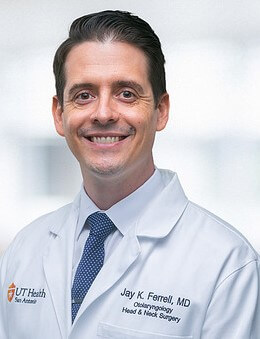
“Because head and neck cancers are unexpected in otherwise healthy young adults, treatment can be delayed, and by the time they see a specialist, the cancer may be beyond the scope where surgery would be impactful,” said Jay Ferrell, MD, FACS, associate professor in the Department of Otolaryngology in the Joe R. and Teresa Lozano Long School of Medicine at The University of Texas at San Antonio, chief of the Division of Head and Neck Surgery and leader of the head and neck robotic surgery program at UT Health San Antonio’s Mays Cancer Center and Multispecialty and Research Hospital.
When caught early, the overall cure rate of HPV-related head and neck cancers exceeds 80% to 90%. However, because patients are so young, physicians must weigh not only the benefits of survival but also the decades-long consequences of radiation and chemotherapy. Over the last 10-15 years, a new, evolving technology is offering hope for improved treatment, shorter recovery, fewer complications and the possibility of reducing or avoiding radiation or chemotherapy altogether.
Rise of robotic surgery in head and neck cancer treatment
Transoral robotic surgery (TORS) using the newest generation single-port (SP) system is one of the most transformative advances to date in the treatment of head and neck cancers. During the procedure, the surgeon sits at a control panel to operate robotic arms and a camera. The SP robot used at the UT Health San Antonio Multispecialty Hospital is specifically designed and FDA-approved for head and neck surgeries and is smaller and more maneuverable than older-generation robotic systems. It is equipped with a much smaller camera than older systems that provides the same high definition, simulated three-dimensional visualization. Additionally, because the camera can rotate 360 degrees within the surgical field, surgeons can achieve enhanced visualization that was previously either precluded by anatomic constraints or required repositioning the entire setup. Robotic surgery also offers enhanced surgical precision as the system filters out a surgeon’s natural, subtle tremor.
During TORS, the surgeon uses the natural opening of the mouth to access malignancies in the oropharynx, including the tonsils and base of the tongue. By performing an “en bloc” resection — removing the tumor along with a margin of healthy tissue — surgeons can send the specimen to pathology and determine whether additional treatment is needed.
Before robotic technology, performing true, oncologic resections of these deeper regions of the throat often required large, invasive surgeries with prolonged recoveries and significant impacts on speech and swallowing. In the late 1990s, following the landmark VA Larynx Trial, head and neck cancer care shifted toward concurrent chemotherapy and radiation as these treatment modalities provided overall high cure rates with better preservation of native tissue compared to “traditional” surgeries. However, by the 2010s, robotics had matured across several specialties including urology, gynecology and oncology, and head and neck surgeons began to adopt it.
“It is minimally invasive, with the additional technology of the robot,” Ferrell said. “We began using it in head and neck surgery and it provided in-depth, high-definition visualization that was previously lacking. It also allows for instrumentation to reach around corners and achieve angles that were previously inaccessible.”
Ferrell emphasized that proper patient selection is critical. TORS is particularly effective for early-stage tumors that are relatively limited to the tonsils or base of the tongue. In the right patient, robotic surgery can eliminate the need for chemotherapy and significantly reduce radiation doses that patients would otherwise receive with standard, concurrent chemoradiation therapy regimens. This treatment de-escalation is the primary value proposition for TORS.
TORS is not appropriate for all patients. Individuals with advanced-stage disease, anatomic limitations — such as restricted oral opening or cervical spine immobility — or significant medical comorbidities that increase overall surgical risk may not be suitable candidates. Even with the enhanced access provided by the TORS system, adequate surgical exposure remains essential to ensure safe resection and complete tumor removal.
Every head and neck cancer patient at UT Health San Antonio is reviewed in a weekly multidisciplinary board. The team evaluates whether surgery can be performed safely, whether it will meaningfully reduce the need for chemotherapy or radiation and whether the tumor’s size and characteristics make it a candidate for TORS.
Short and long-term benefits for patients with HPV cancers
Head and neck cancer researchers became increasingly aware of HPV’s link to tonsil and base-of-tongue cancers about 15 years ago, and the incidence of HPV-related oropharyngeal cancer has only continued to rise in the United States since that time.
“With robotic surgery, there is often less radiation overall, and with every dose reduction that we can safely do, we reduce both acute toxicity and long-term sequelae,” Ferrell said.
For young patients with HPV-mediated cancers, this matters. Though these cancers respond well to radiation, the long-term effects can be considerable.
“These patients have a much longer time horizon to experience potential sequelae from full-dose chemo-radiation protocols,” Ferrell said. “Treating cancer is most important, but preserving long-term function is a very close second.”
TORS also reduces the likelihood of short- and long-term issues like throat pain, swelling, scarring and swallowing difficulty — concerns that carry major quality-of-life implications for decades to come.
“Traditionally, these cancers affected older men with heavy smoking histories. Now we’re treating patients in their 30s and 40s. We don’t yet know what the effects of radiation will look like when they’re in their 60s, 70s and 80s,” Ferrell said.
TORS has been in use at UT Health San Antonio since 2017, and today the institution has one of the most prolific head and neck robotics programs in the region and is the only program offering this level of expertise in South Texas as part of a larger National Cancer Institute-designated Cancer Center.
Integrating robotic surgery into training and care
Ear, nose and throat (ENT) residency provides broad surgical training, but advanced procedures like TORS typically require fellowship-level specialization. At UT Health San Antonio, robotics is increasingly integrated into resident education. With Ferrell and two additional TORS-trained surgeons, trainees now have expanded opportunities to participate.
The single-port system enables dual-console training, similar to driver’s education. Residents can operate in tandem with the attending surgeon or serve as first assistants, gaining familiarity with robotic setup, positioning and soft-tissue handling. Over time, senior residents may safely perform limited parts of a procedure, such as taking margins or removing a benign contralateral tonsil.
Passion for patient care
Ferrell’s path to head and neck oncology was a blend of curiosity, technology and the desire to provide hope for patients in their darkest times. Early in his medical training, he found himself drawn to ENT surgery’s blend of technical skill and the connection with patients that is crucial in cancer treatment.
“Even on the best days, it’s challenging,” he said. “You meet patients during some of the worst periods of their lives. Cancer sometimes has its own plans, and you must be prepared to be there with them, even when options are running out.”
Multidisciplinary model for South Texas
The National Cancer Institute-designated Mays Cancer Center’s partnership with MD Anderson provides standardized protocols and collaborative expertise. The associated UT Health San Antonio Multispecialty Research Hospital offers integrated robotic surgery with seamless access to speech-language pathology, nutrition, rehabilitation, radiology and oncology, creating a comprehensive continuum of care.
“For community physicians, the message is simple,” Ferrell said. “If you have an adult patient with a neck mass, have a low index of suspicion for possible head and neck cancer, and send them to us if there is any concern. HPV-driven cancers are on the rise, and early detection is key. Maybe they’re a candidate for robotic surgery, maybe not. But we can evaluate them and build a customized treatment plan that is best suited for each individual patient.”
HPV-related head and neck cancer is no longer an obscure disease affecting older smokers. It can affect patients of all ages and from all walks of life. And with early detection and access to advanced tools like TORS at the UT Health San Antonio Multispecialty Research Hospital, patients can expect highly effective, personalized treatment with the best chance of preserving their equally precious quality of life.
For more information about head and neck cancer treatment at UT Health San Antonio call 210-450-1000 or visit Mayscancercenter.org. To schedule an appointment, visit Mayscancercenter.org/appointments.