


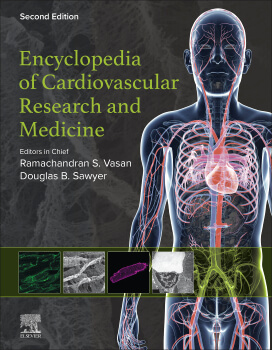
As cardiovascular science advances at a rapid pace, the second edition of the Encyclopedia of Cardiovascular Research and Medicine has arrived as a timely and essential guide to a field being reshaped by discovery, technology and increasingly interdisciplinary approaches, said Co-Editor-in-Chief Vasan Ramachandran, MD, FACC, FAHA, dean of the Kate Marmion School of Public Health at The University of Texas at San Antonio.

The updated encyclopedia, published in May, reflects new areas of science that have grown exponentially since the first edition was released in 2018, Ramachandran said. These include cardio-oncology, vascular immunobiology and cardiovascular genomics, a field that combines cardiology and genetics to provide personalized preventive and targeted treatments.
“What the second edition tries to do is to take the first edition and fast-track it into the new era we find ourselves living in,” said Ramachandran, a cardiologist and epidemiologist who also served as co-editor-in-chief of the first edition.
Deep learning and molecular advances open new frontiers in heart medicine
The multi-volume second edition taps into the growing momentum of artificial intelligence and today’s most cutting-edge biomedical techniques. These include gene editing, which changes an organism’s genetic code, and gene silencing, which switches off disease-causing genes. Both techniques could help inform new treatments, Ramachandran said.
“I think a lot of cardiovascular medicine was more bedside, interpreting values and making decisions which are standardized,” Ramachandran said. “Now, I think we’re getting into [a time period] where molecular tools, genetic tools and imaging tools get us into the precision medicine era in cardiology.”
Advances in molecular medicine and technology, along with AI, will likely revolutionize the practice of cardiovascular medicine, Ramachandran said.
Physicians can now use innovative simulation techniques, visualization tools and the kind of deep learning that comes with AI. In fields such as electrophysiology, AI can be used with imaging tools to test and treat heart rhythm disorders, Ramachandran said.
In the area of molecular medicine, treating cholesterol in a one-size-fits-all fashion may give way to gene-editing techniques in which a gene can be altered with an injection, changing the variant that causes high cholesterol and allowing someone to maintain normal levels throughout their life, he said.
A practical resource for learners and experts alike
Building on the first edition published by global academic publishing and information analytics company Elsevier, the second edition serves as a resource for every stage of cardiovascular learning, from students who are looking for foundational knowledge, to experts who can quickly scan information for the latest information and take a deeper dive by accessing the citations.
“The second edition is more like a 10,000-foot quick summary that is pretty comprehensive and captures the expanse in very limited space with the key points that you want to know,” Ramachandran said. … “It’s a very tiered approach where it covers the breadth and it goes up to a depth and then gives you the references to [drill] deeper.”
Written and edited by international experts in cardiology and vascular medicine, the second edition covers the cardiovascular system in health and disease; includes foundational content for readers entering the field and more advanced materials for experts; and takes an interdisciplinary approach to examine socioeconomic factors in cardiology.
The edition is described as taking a “bench-to-bedside-to-population” approach.
“We cover basic science, we cover clinical science and we cover population science,” Ramachandran said. “If you’re a basic scientist, you’ll find something about molecular tools and what is to be done. If you’re a clinician, you’ll find out about how heart attacks are managed.
If you are a population scientist, you’ll understand the patterns of heart disease and how we have healthy patterns of health and promote health. It’s a continuum, from the bench, which is basic science, to the bedside, which is clinical medicine, to population, where we’re talking about groups of people.”
To keep up with the latest in scientific discoveries, the revised edition is available in both print and digital formats.
“I think in today’s information [age], anything you put out there digitally gets dated pretty quickly because new discoveries are made,” Ramachandran said. “We wanted to make sure that at the time of its release in May, [the second edition] was as up to date as it can be. And then the digital modality enables us to … periodically update the chapters online.”
Connecting clinical cardiology with the patterns behind heart disease
Ramachandran’s work has long focused on understanding why patterns of disease occur. He served as principal investigator of the Framingham Heart Study from 2014 to 2022 and now leads the National Heart, Lung, and Blood Institute-funded Risk Underlying Rural Areas Longitudinal Study, or RURAL, which examines cardiovascular health disparities in the rural South.
“I think my work as an epidemiologist, understanding why these patterns occur, the upstream causes and how they result in downstream disease, understanding that continuum is very important,” he said. “One of the metaphors I use is [to] imagine a conveyor belt with a tap on one side and water is flowing down on the other side. You could keep mopping. That’s what clinical medicine often does. But somebody needs to shut off the tap. And upstream is when you shut off the tap, when you begin to understand why people are sick in the first place.”
Reflecting a commitment to continual learning
Having served as co-editor-in-chief for both editions of the encyclopedia, Ramachandran said that working on the revision reflects his deep passion for learning and teaching.
“Being an editor is probably the best way to learn,” he said. “It keeps you alive and it keeps you updating yourself because you cannot teach the most updated stuff unless you read the updated stuff. And then you not only read it, you also need to understand it, then you teach it. And it goes back to what we call Bloom’s taxonomy. It’s very much you learn by doing. So, I think this encyclopedia reflects a passion to teach. That’s who we are in a school. We teach. And we learn, and that’s [the] cycle.”
The Encyclopedia of Cardiovascular Research and Medicine (2nd Edition) is now available online via ScienceDirect and in print through Elsevier.