



The accumulation and tangling of tau proteins is a well-known feature of Alzheimer’s disease. Less understood is how different forms of tau are regulated and what happens to that balance as the brain ages and neurodegenerative disease develops.
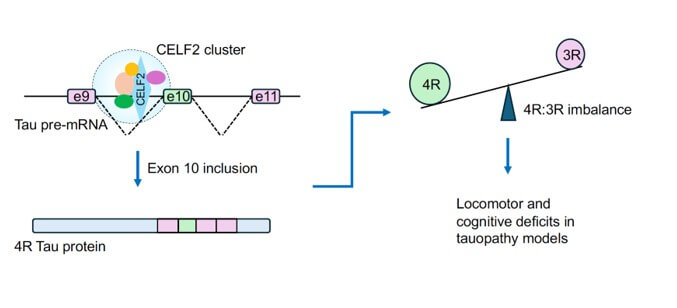
A study from The University of Texas at San Antonio’s Health Science Center published in July in Nature Communications highlights the importance of CELF2, an RNA-binding protein, in regulating the alternative splicing of tau.
Alternative splicing allows cells to include or exclude sections of a gene’s RNA message, enabling a single gene to produce multiple forms of a protein. For tau, this process determines whether cells produce 3R or 4R tau, two forms that differ by one microtubule-binding region.
The distinction is important because tau aggregation is strongly associated with neurodegeneration, and 4R tau, which has an additional microtubule-binding region, can bind more tightly and form aggregates more quickly than 3R tau.

Lizhen Chen, PhD, associate professor in the Department of Cell Systems and Anatomy at the Joe R. and Teresa Lozano Long School of Medicine, began investigating CELF2 during a genome-wide genetic screen designed to identify proteins important for nerve regeneration after injury. The screen identified CELF2, which regulates various processes including RNA splicing and RNA decay.
Chen became interested in the protein’s potential role in neurodegeneration after other studies identified genetic variants associated with Alzheimer’s disease risk.
“When you see something is associated with higher disease risk or lower, they’re both interesting because we could try to look at both directions,” Chen said.
Her team identified multiple downstream targets of CELF2, including tau.
Regulating the balance of tau
Tau is produced from the gene that contains multiple exons, or sections of genetic information that can be combined in different ways during RNA splicing.
One of those sections is exon 10. When exon 10 is included, the resulting protein is 4R tau. When it is excluded, the result is 3R tau.
The balance between the two forms changes throughout life. In young humans and animals, 3R tau is predominant. As the brain develops, 4R tau increases. In the adult human brain, the two forms are present at equal levels, then 4R tau becomes more dominant with aging.
Chen’s research team found that CELF2 is an important regulator of this process.
The team saw how CELF2 forms clusters within cells through an intrinsically disordered region of the protein. These clusters can recruit other proteins that influence how CELF2 regulates tau splicing.
Two such proteins, SFPQ and NOVA2, had opposite effects. When CELF2 clustered with SFPQ, 4R tau formation was enhanced. When it clustered with NOVA2, the process acted like a brake, slowing tau splicing.
“Depending on what cofactors or other proteins are recruited to the membrane-less cluster, the outcome of splicing is different,” Chen said.
The team also identified a highly conserved, negatively charged amino acid residue, D388, that appears to be important for CELF2’s ability to cluster and function. Changing the residue to another negatively charged amino acid had little effect, while changing it to a positively charged amino acid stopped CELF2 function.
Potential implications for Alzheimer’s disease
To understand CELF2’s role in tau regulation, the team used a CELF2-knockout animal model.
When CELF2 was deleted, the balance of tau isoforms changed, with less 4R tau and more 3R tau. The study supports the idea that CELF2 normally promotes the production of 4R tau and the discovery could eventually point toward ways of manipulating 3R and 4R tau ratio.
Chen said that lowering 4R tau could be a possibility for slowing Alzheimer’s disease progression, but the approach would need to be validated beyond animal models.
The focus on CELF2, rather than ratio of tau, is of interest for another reason. Along with tau, CELF2 has several downstream targets, including amyloid precursor protein (APP), which helps produce amyloid beta, another factor in Alzheimer’s disease.
“By targeting CELF2, we can simultaneously affect multiple Alzheimer’s disease-related genes like tau and APP, instead of targeting them one by one,” Chen said.
Next steps in human brain tissue
The next step in Chen’s research is determining whether the mechanisms identified in laboratory models also occur in people with Alzheimer’s disease.
Chen is collaborating with the Glenn Biggs Institute for Alzheimer’s and Neurodegenerative Diseases and the Brain Bank to examine post-mortem human brain tissue. The scientists will look at whether CELF2’s function or cellular location differs between healthy brains and brains affected by Alzheimer’s disease.
The findings from this study add some insight into how tau is regulated in neurodegenerative disease. Understanding that regulation could help scientists determine whether altering the balance of tau forms is a viable strategy for slowing neurodegenerative disease.
“By identifying CELF2 as an upstream regulator of tau splicing, our study provides another piece of this puzzle,” Chen said.
Li X, Syed I, Adhikari R, Jiang J, Zhang Y, Tang D, Ko SH, Zhang Z, Liu Z, Chen L. CELF2 promotes 4R Tau splicing via nuclear clustering and drives cognitive dysfunction in tauopathy models. Nature Communications. July 2026;17(1). https://doi.org/10.1038/s41467-026-76241-9