


Contact: Steven Lee, (210) 450-3823, lees22@uthscsa.edu
Content by Claire Kowalick
SAN ANTONIO, Jan. 27, 2026 – Researchers at the new Center for Brain Health at UT Health San Antonio are studying midlife testing for early-onset dementia with blood-based biomarkers to see if they can detect disease activity up to 20 years before symptoms appear.
The tests are available clinically and soon will be tested locally at the Glenn Biggs Institute for Alzheimer’s and Neurodegenerative Diseases at the brain health center, alongside advanced imaging such as amyloid and tau PET scans and cerebrospinal fluid testing. UT Health San Antonio is the academic health center of The University of Texas at San Antonio (UT San Antonio). The center also is exploring emerging genetic treatments for dementias, including early-onset Alzheimer’s, with multiple trials underway.
While Alzheimer’s disease accounts for 60% to 80% of all dementia cases, early-onset Alzheimer’s, often defined as Alzheimer’s with symptoms appearing before age 65, is less common but can be more devastating. It affects about 3.9 million people ages 30 to 64 worldwide, according to a 2021 report in JAMA Neurology.
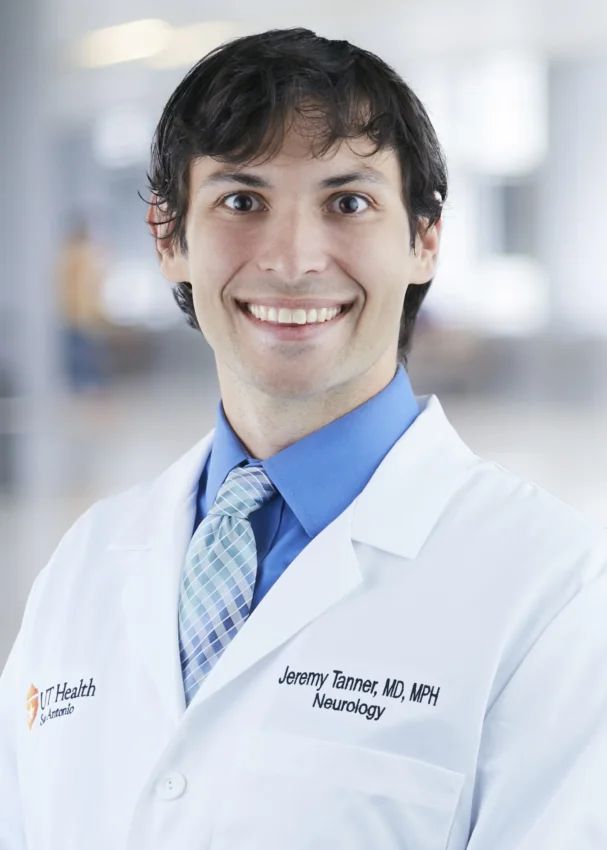
“Dementia is a clinical syndrome in which a person develops progressive cognitive changes from their prior baseline,” said Jeremy Tanner, MD, PhD, assistant professor in the Department of Neurology at the Joe R. and Teresa Lozano Long School of Medicine at UT San Antonio and the Biggs Institute. “When these changes begin to affect daily function, that’s when mild cognitive impairment progresses to dementia.
“When Alzheimer’s occurs earlier in life,” he said, “people are often at the peak of their careers or raising young families. It’s something that can be missed or misdiagnosed, and by the time it’s recognized, the disease may already be advanced and progressing rapidly.”
Fortunately, researchers now have more precise ways than ever before to detect Alzheimer’s disease earlier, including with blood-based biomarkers like p-tau217.
“If a blood test is negative, that can be reassuring,” Tanner said. “If it’s positive, we follow up with confirmatory testing to ensure accuracy. The goal is to diagnose and begin treatment earlier in order to delay, or ultimately stop, the disease.”
For years, he says, younger adults with cognitive symptoms often were told they had depression, anxiety or even post-traumatic stress disorder as the cause of severe cognitive impairment.
“I’ve seen patients misdiagnosed for years,” he said. “Only recently are we beginning to identify early-onset Alzheimer’s disease and understand how important accurate diagnosis can be.”
Dementia also carries a major economic impact, especially when it affects younger adults. “If your brain isn’t healthy, you can’t engage fully in your work, with your family or your community,” Tanner said. “Optimizing brain health isn’t just a medical priority, it’s a social and economic one.”
The genetic perspective
While some forms of Alzheimer’s disease are linked to genetic mutations, called autosomal dominant Alzheimer’s, this represents less than 10% of early-onset cases. Most diagnoses of early-onset dementia are sporadic, meaning the cause is unknown.
Tanner said this underscores the importance of continued research into lifestyle, environmental and lesser-known genetic risk factors for early-onset dementias.
“We only get one brain, and our goal is to help the brain function as well as it can for as long as it can,” he said. “Research is how we get there.”

That’s where Julia Castro, ScM, CGC, a genetic counselor with the Biggs Institute, comes in.
Gene therapy approaches vary depending on the problem. For example, if a gene is overactive or harmful, therapy may aim to neutralize it. If a gene is not functioning properly, therapy may introduce a healthy copy. Delivery methods, dosage and frequency all depend on the specific therapy and gene involved.
“While we don’t yet have FDA-approved gene therapies for Alzheimer’s, there are multiple clinical trials underway for various types of dementia, including frontotemporal,” Castro said. “Seeing these trials move forward is exciting because they’re paving the way for other dementias.”
Genetic testing can help families plan and make informed health decisions, but it’s not always easy news to deliver.
“It’s hard to tell someone their genes put them at higher risk when we don’t yet have a cure,” Castro said. “But knowledge is power, and with lifestyle modifications and early monitoring, we can make a meaningful difference.”
Beyond single-gene mutations, the latest genetic testing is exploring polygenic risk – the combined effect of multiple genes that each slightly increase risk.
“For families with a history of dementia, these medium- and low-risk genes that add up may explain more than the rare high-risk ones,” Castro said. “Polygenic risk scores could allow us to monitor at-risk individuals earlier and guide lifestyle interventions proactively.
The role of lifestyle and prevention
Genetics are only part of the story when it comes to dementia risk. Lifestyle factors such as cardiovascular health, stress management, sleep, diet and social engagement play a significant role in brain health across the lifespan.
“Some genes increase dementia risk indirectly by affecting blood vessels and heart health,” Castro said. “That’s why what’s good for your heart is usually also good for your brain.”
In her counseling sessions, Castro helps patients make small, realistic changes.
“I tell people to pick an area or two where they’re already doing well and one or two in which they could improve,” she said. “Then we make a game plan. It’s important for people to have agency over their health.”
Anti-amyloid drugs, which target abnormal amyloid protein buildup in the brain associated with Alzheimer’s disease, are offering new treatment possibilities for Alzheimer’s disease. But Castro notes that genetic factors can affect how patients respond.
“For example, people who carry the APOE e4 gene are more likely to develop Alzheimer’s, but they’re also at higher risk of side effects from these therapies,” she said. “That’s why a personalized approach is so important.”
The goal of the Center for Brain Health is to provide a place of progress and possibility.
“These families carry a legacy of dementia,” Castro said. “With advances in genetics, early detection, lifestyle interventions and new therapies, we can give them knowledge, tools and hope for a life less defined by inherited risk.”
A new model for care
Dementia is one of the most challenging medical and societal issues of our time, affecting memory, thinking and independence for millions of families worldwide. At UT Health San Antonio, researchers and clinicians are taking new steps to change that story through research, genetic insights and compassionate, integrated care.
At the heart of this mission is UT Health San Antonio’s new Center for Brain Health, which opened Dec. 10, bringing together experts in neurology, genetics, neuropsychology and therapy under one roof. The center is the new home of the Department of Neurology and the Biggs Institute.
The Center for Brain Health represents a major step forward for dementia care in South Texas. By bringing specialists together, the center aims to deliver truly comprehensive care.
“These diseases are complex, and it takes a multidisciplinary approach to provide the highest quality care,” Tanner said. “Having everything under one roof makes it easier for patients and families while allowing us to integrate multidisciplinary care with critical research.”
While the center will offer state-of-the-art testing, including PET and MRI imaging, cerebrospinal fluid analysis and advanced biomarker testing, its impact will go beyond diagnostics.
“Our goal is to integrate testing, care and research so that every clinical evaluation can also help us learn,” Tanner said. “Research is how we figure out what protects the brain and how to keep it healthy over a lifetime.”
South Texas has one of the highest rates of Alzheimer’s and dementia in the country, making the work of the Biggs Institute and the Center for Brain Health especially vital.
“We don’t know exactly why this is, but we’re determined to find out,” Tanner said. “By studying risk and protective factors here, we hope to generate insights that can be applied globally.”
UT Health San Antonio is the academic health center of The University of Texas at San Antonio (UT San Antonio), offering a comprehensive network of inpatient and outpatient care facilities staffed by medical, dental, nursing and allied health professionals who conduct more than 2.5 million patient visits each year. It is the region’s only academic health center and one of the nation’s leading health sciences institutions, supported by the schools of medicine, nursing, dentistry, health professions, graduate biomedical sciences and public health that are leading change and advancing fields throughout South Texas and the world. To learn about the many ways “We make lives better®,” visit UTHealthSA.org.
Stay connected with UT Health San Antonio on Facebook, Twitter, LinkedIn, Instagram and YouTube.
The Glenn Biggs Institute for Alzheimer’s and Neurodegenerative Diseases at UT Health San Antonio is dedicated to providing comprehensive dementia care while advancing treatment through clinical trials and research. The Biggs Institute is a National Institute on Aging (NIA)-designated Alzheimer’s Disease Research Center (ADRC). UT Health San Antonio is the academic health center of The University of Texas at San Antonio (UT San Antonio). In addition to providing patient care and conducting research, the Biggs Institute partners with the School of Nursing at UT San Antonio to offer the Caring for the Caregiver program.
The Joe R. and Teresa Lozano Long School of Medicine at The University of Texas at San Antonio (UT San Antonio) is listed among U.S. News & World Report’s best medical schools, among the top 5% of universities globally for clinical medicine research and ranked as the third-highest medical school in Texas for medical research funding by the National Institutes of Health. The Long School of Medicine supports the university’s academic health center, UT Health San Antonio.