


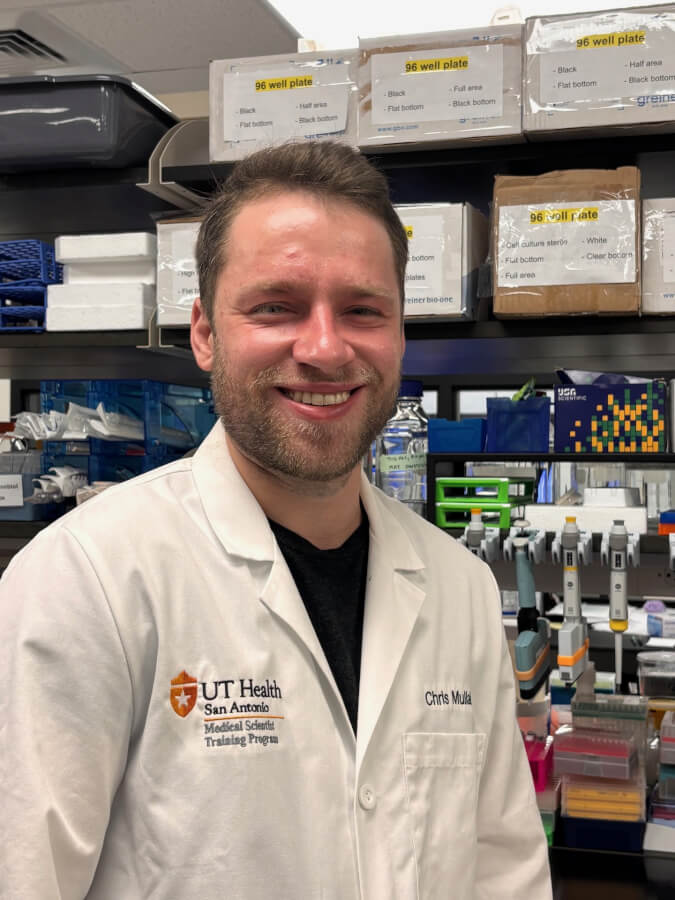
A third-year MD/PhD graduate student from The University of Texas at San Antonio (UT San Antonio), Christopher Mullally, recently received funding from the National Institutes of Health National Cancer Institute for a project examining how the body regulates internal sources of mutation and how breakdowns in that regulation may contribute to cancer development.
While it has long been understood that cancer is driven by mutations, a great deal of the research has focused on external factors like carcinogens from tobacco smoke. Mullally’s research aims to broaden this perspective by focusing on internal drivers of mutation.
Mullally, who studies under the mentorship of Reuben S. Harris, PhD, Howard Hughes Medical Institute investigator, and professor and chair of the Department of Biochemistry and Structural Biology, scored within the top 1 percentile for his research proposal.
Discovery that reshaped cancer research
About 25 years ago, Harris discovered that the body expresses a family of enzymes called APOBEC3 that mutate DNA.
“Many of these enzymes have specific viruses that they target, which are encoded in DNA and RNA,” said Mullally.
During normal functioning, when a cell is infected, it expresses one of these restriction factors, which mutates the virus to prevent its ability to spread. Harris’ lab was the first to report that mutations from this family of enzymes play an important role in cancer. The APOBEC3 mutational signature is found in 70% of cancers and 50% of all tumors.
How cancer creates an escape route
Follow-up studies from the Harris Lab and others have shown that APOBEC3 can drive tumor formation, while other work shows the enzymes can be switched on or off, depending on the need.
When a cancer treatment is introduced, for example, it can kill off many of the cancerous cells. However, the ones that survive often upregulate the expression of APOBEC3 enzymes and increase their mutational burden.
From this observation, a prominent hypothesis in the field is that cancer cells can use these enzymes to push their own evolution to escape drug therapy.
“This [APOBEC3 enzymes] is going to be a factor in different degrees, but it is showing up again and again as a strategy employed by different cancers,” Mullally said.
Searching for the “switches”
Since normal tissue can express these enzymes without becoming cancerous, Mullally said it suggests a hidden level of regulation, something that keeps the mutations in check that cancer learns to bypass. He and his collaborators will investigate how these mutagenic proteins are regulated normally and how they can start damaging healthy cells.
While a great deal of the research is on APOBEC3A, Mullally focuses on the unique aspects of APOBEC3B. APOBEC3B is different from other APOBEC enzymes. It is highly expressed in cancer systems and is located in the nucleus of cells, while other APOBEC enzymes are found in the cytoplasm, the area of the cell outside of the nucleus.
Despite being made in large amounts and being close to cellular DNA, APOBEC3B’s presence does not always mean more mutations.
“There must be a switch, a factor that determines whether or not there will be a mutagenic signature,” Mullally said.
Shift in focus
Mullally was originally going to conduct his major research on APOBEC3A but changed his focus after discussing data generated by a fellow student on APOBEC3B.
“Together we came up with a hypothesis that there must be a regulator,” he said.
Mullally said Harris encourages his students to pursue bold research in what he calls “Saturday experiments.”
“We tested it one weekend and it worked astoundingly well. We got a phenotype that we wanted to study further,” Mullally said.
National Cancer Institute training research grants can be incredibly competitive, and Mullally said he tried to showcase the collaboration and breadth of expertise of his team, which includes cellular, biochemistry, computational and in vivo animal models experts.
“I knew I would need help, and I’m learning about all these different kinds of research. I have had great mentors and support along the way,” he said.
Path of a future scientist
Mullally grew up in Boston and knew from a young age that he was interested in science and medicine. He recalls that when he was eight years old, he had a fill-in-the-blank children’s book in which he wrote that when he grew up, he wanted to be a scientist.
“I don’t even know if I spelled it right or if I knew what a scientist did. But that book is going to be with me when I present my dissertation,” he said with a laugh.
In high school, he became even more focused on medicine and biomedical research.
“I was developing a passion for service and a desire to directly meet people’s needs and problems through compassionate care. The MD/PhD track merges those two. These two motivations came together hand in hand over time,” he said.
Why UT San Antonio
Mullally said he was drawn to UT San Antonio Health Science Center because of its exceptional programs and world-renowned researchers.
“I realized there were so many opportunities here and I could have a great start to a scientific career,” he said.
Mullally said he especially enjoys the creative aspects of research.
“One of the most gratifying things to me is having an idea, thinking about the problems, learning new things and then applying that knowledge. It’s a wonderfully creative and collaborative process. The altruistic aspect is important, and I feel that in my heart, but I also really enjoy the process,” he said.
After graduation, Mullally said he hopes to continue his education with a residency/fellowship program focused on oncology.