

New $5 million commitment enables incoming DDS students to train on same end-to-end technology they’ll use with patients in their third and fourth years
Contact for media: Steven Lee, (210) 450-3823, lees22@uthscsa.edu
SAN ANTONIO, Oct. 26, 2026 – Students in all four years of the Doctor of Dental Surgery (DDS) program at the UT San Antonio School of Dentistry now are working on the same complete digital workflow for dental restorations, whether they are training in the lab or treating patients in the clinic. The single-sourced system runs from 3D oral scanning at chairside to the precise milling and fitting of crowns and bridges, better aligning students with how they will practice in the most advanced of settings.
And the school is the only one in the nation running this particular end-to-end workflow from Austria-based manufacturer Amann Girrbach, a major international digital prosthetics company. The technology is part of a more than $5 million commitment over five years by the university and the Department of Predoctoral Dental Education.
Most dental schools that provide complete digital workflows don’t introduce them until the third or fourth years. And until this year, students at UT San Antonio didn’t encounter one until later in the program, working with “analog” techniques in their early years – such as taking putty-tray impressions and using a facebow to record patient jaw relationships.
Now, both digital and analog methods remain in the curriculum, but students master both techniques side by side, and from the very start.
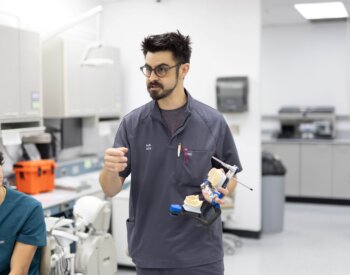
“What it really shows is that we’re on the cutting edge,” said Raul Jose Bonilla, DDS, who is spearheading the effort as a clinical assistant professor and director of dental anatomy with the Department of Predoctoral Dental Education, at the state’s leading dental school. “And we’ve always been doing that. It’s what we can do to always be progressing, not only ourselves but the profession itself.”
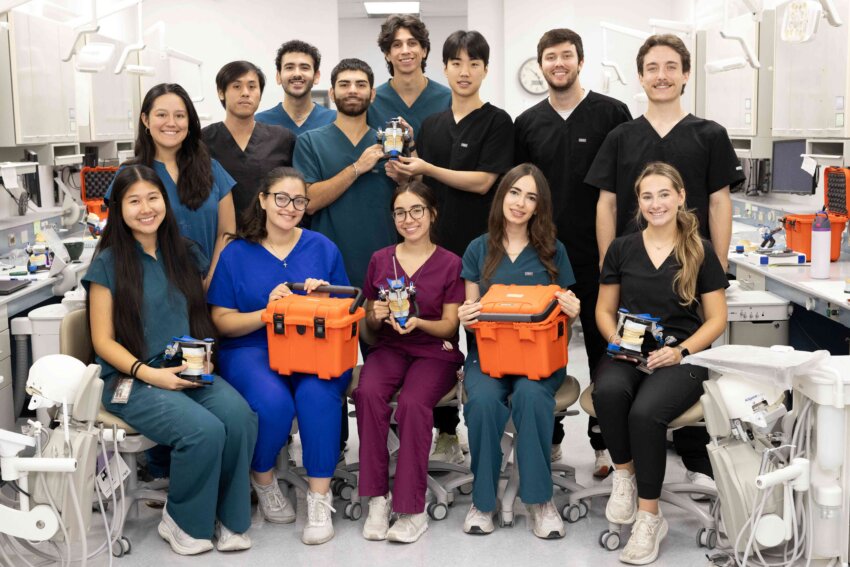
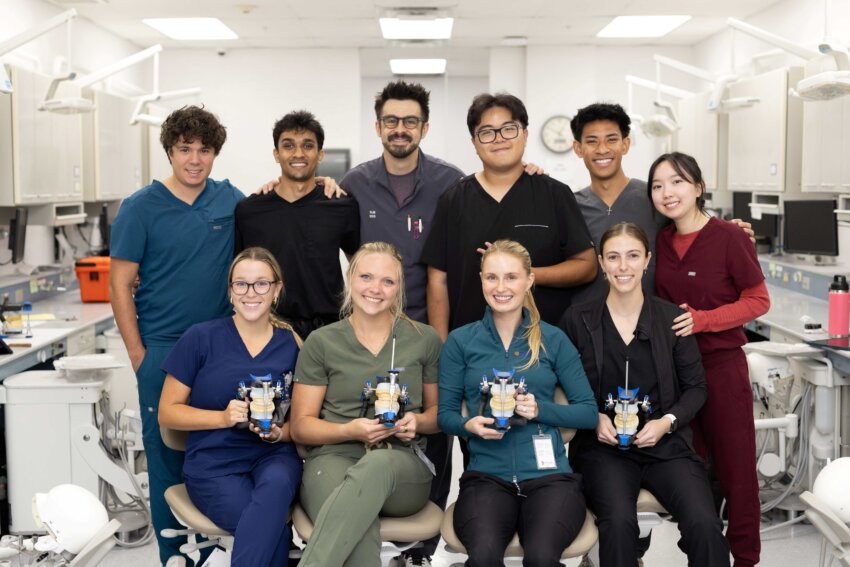
To support the initiative, this year’s 100 incoming dental students received dental articulators, which are devices that reproduce the way an individual patient’s jaw opens, closes and slides, along with the software that links them to the same workflow they will use on patients two years from now at the school’s clinic.
The school also upgraded and expanded its fleet of intraoral scanners, which are handheld devices that capture precise three-dimensional images of the teeth and soft tissues, adding 16 units to the clinic floor. All tie into the same Amann Girrbach system.
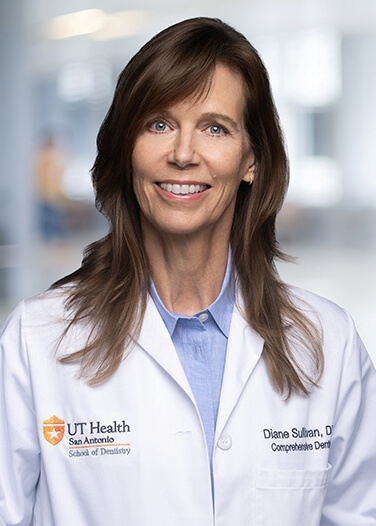
“As the academic home where future dentists begin their journey, we cultivate an environment centered on evidence-based science, excellence in dental education and compassionate patient care,” said Diane J. Sullivan, DDS, professor and chair of the Department of Predoctoral Dental Education. “Adopting and applying advanced technologies like this complete, digitized workflow for dental restorations is one more way we grow skilled clinicians and leaders in oral health.”
“Access to state-of-the-art technologies, both hardware and software, is transforming the way we teach and prepare our students,” said Carlos David Escobar Palma, DDS, director of digital dentistry and clinical assistant professor at the school. “It also creates valuable opportunities for faculty professional development and, most importantly, allows us to provide our patients with an even higher level of care.”
How it flows
The full digital workflow begins when a student scans the patient’s teeth and soft tissues with an intraoral scanner. Scanning software converts those images in real time into an interactive surface model displayed on a chairside monitor.
A high-precision jaw motion sensor, worn on a lightweight head frame, then tracks and records the patient’s individualized jaw motions. This data works in tandem with the patient’s scans inside prosthetic design software, where the restoration is designed against that patient’s anatomy and bite.
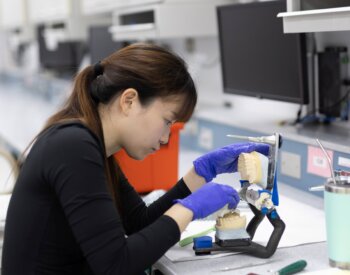 The design is then sent to one of the school’s in-house milling machines, which produces the finished crown or bridge. A 3D printer can also produce provisional restorations, as well as resin models of the patient’s mouth. Printed models snap onto the dental articulator, where they serve as a teaching tool for students along with being a method to verify restorative work before the prosthetic is tried chairside.
Bonilla emphasizes that this high-tech integration is important for establishing clinically relevant, hands-on exercises. Because every student works from an identical digital file, longstanding variables such as articulator mounting discrepancies, facebow transfer inconsistency and differences between operators disappear. A single digitally designed exercise can be printed in multiples and used identically across operative, fixed and removable prosthodontic courses, giving every student the same reference point from the first year onward.
Because students master the complete workflow well before they treat patients, they enter the clinic already fluent in how scan quality, articulator settings, design parameters and milling or printing interact and integrate. They can assess an intraoral scan, recognize potential issues, make modifications and communicate precise adjustments to the milling center. The practical results are fewer remakes, shorter chair times and restorations that more accurately preserve and replicate each patient’s existing anatomy.
A partnership years in the making
 The workflow installation is the product of a relationship built over several years. Richard Zimmermann, DDS, clinical associate professor with the Department of Predoctoral Dental Education, is credited with originating the relationship with Amann Girrbach.
With his initiative and focus on research and development, the school became a secondary or “beta” tester of the company’s latest milling machine at the time. The school since has purchased two additional milling machines from the manufacturer, and all three are used as part of the full workflow.
A recent presentation on the workflow by company representatives drew faculty from across the school, from adjuncts teaching first-year dental anatomy to prosthodontists who specialize in complex oral reconstruction and cosmetic dentistry.
“I would say that for each one of our clinical teams and restorative courses, the team leads were there, and the assistant leads were there,” Bonilla said. “So, you’re getting every single year that is interested, saying, ‘Whoa, this is coming.’ They’re there learning and saying, ‘OK, how can we really start?’”
Afterward, Tom Watkins, DDS, a long-serving clinical professor and local practitioner who graduated from this dental school in 1980 and now teaches part time, marveled at how far things have progressed.
“The student goes out prepared to be able to do it digitally as well as the old-fashioned way. They can do that,” he said. “You know, it’s come a long way. It’s just phenomenal what we can do, and it really makes dentistry so much more fun.”
The School of Dentistry at The University of Texas at San Antonio (UT San Antonio), ranked as the No. 1 dental school in Texas by the Blue Ridge Institute for Medical Research, offers 18 degrees and programs in both dentistry and dental hygiene, world-renowned faculty educators, a diverse student population, state-of-the-art clinical facilities and a distinguished research enterprise. Departments include comprehensive dentistry, developmental dentistry, endodontics, periodontics, predoctoral dentistry, and oral and maxillofacial surgery. Scientists collaborate with clinicians and research teams worldwide, and work across multiple medical and dental disciplines to find new treatments, advancing knowledge of oral health, biomaterials, cancer, pain and more. It supports the university’s academic health center, UT Health San Antonio. UT Dentistry, the clinical practice of the School of Dentistry, practices in the Center for Oral Health Care and Research, serving the general population. To learn more, visit https://www.uthscsa.edu/academics/dental.
Stay connected with UT San Antonio School of Dentistry on Facebook, LinkedIn and Instagram.