


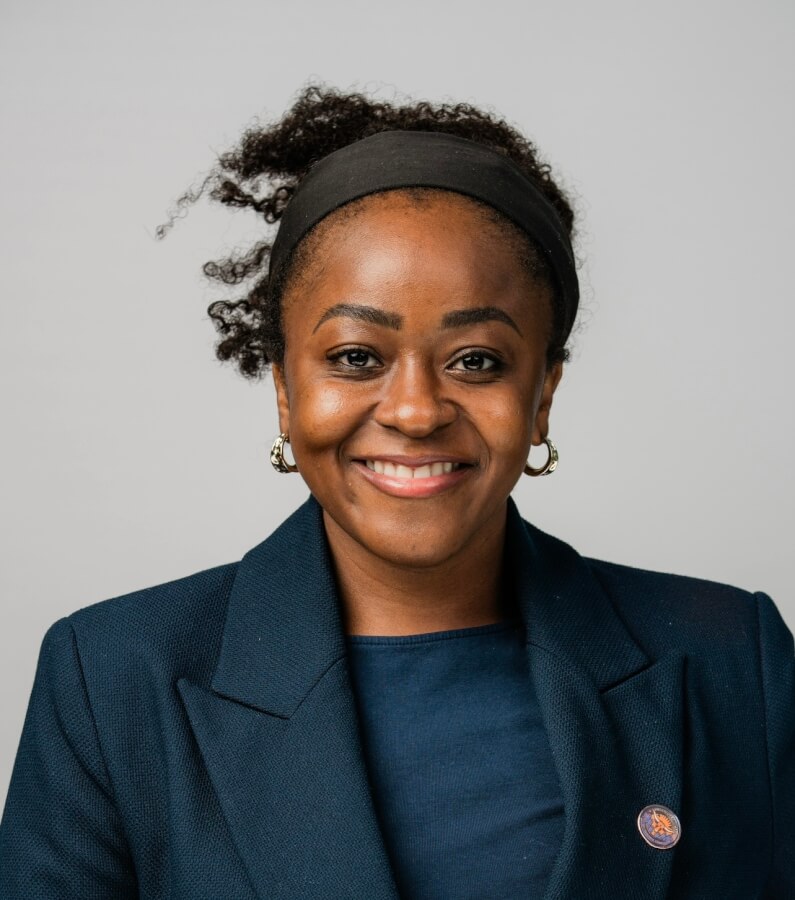
It was at nine years old that Nana Opoku-Ansah first sat in a dental chair, not realizing that moment would inspire her future.
She had tagged along to her mother’s dental appointment, curious and observant. When the visit ended, she asked the dentist if he could take a quick look at her teeth, too. That simple request set off a chain of events that included a referral to an orthodontist, five years of treatment and ultimately, a transformation that far outweighed the simple realignment of her teeth.
“I didn’t smile a lot when I was young, but dental care changed my attitude and my confidence,” she said. “I realized that it really had an impact on me and my personality. I had a good experience, now, let me give others a good experience.”
That good experience turned into her calling.
This May, Opoku-Ansah, BDS, MPH, will graduate from The University of Texas at San Antonio School of Dentistry through its International Dental Education Program, completing a credential that has taken her across three continents and demanded everything she had.
Into the unknown
The path that brought her to San Antonio is not a short one to trace.
After completing dental school in Ghana, Opoku-Ansah pursued a master’s degree in dental public health in the United Kingdom, where she lived in London, a city she said has a fast-paced, buzzing energy that she enjoyed.
“People are always on the go,” she said. “That’s kind of how I am.”
While in the U.K., she realized that though she already held a dental degree and was already an accomplished clinician, she wanted more. Specifically, she wanted what the United States had to offer.
“If you are looking for leadership in the dental profession, the U.S. leads other countries,” she said. “If you want career advancement, if you want to learn more, if you want to do more advanced continuing education, it’s here.”
She had a motive to take the leap. She just didn’t think she’d get in.
“I didn’t think I could do it,” Opoku-Ansah said. “But I thought, if I want to be the best clinician I can be, the U.S. is where I need to be.”
So, she pressed forward and applied to the program, flew in for admission interviews and practical examinations, then returned home to wait.
“I kind of jumped into the pool and thought, I’ll figure out how to swim if it happens for me,” she said. And it did. Opoku-Ansah was offered a spot to earn her Doctor of Dental Surgery degree, which would enable her to practice dentistry in the U.S., creating new possibilities for her professional future.
Listening as a form of care
On any given day, when Opoku-Ansah arrives at the Center for Oral Health Care and Research she is organized and prepared for a day in clinic. However, when things don’t go as planned — and in the clinic, they often don’t — she’s learned how to pivot, and listen, without losing her footing.
“I once had a patient, an older gentleman in his 80s, who arrived anxious,” she said. “My instinct was to engage him in conversation because the distraction seems to settle nervous patients.” The tactic wasn’t working.
“He wasn’t rude about it or anything, but he let me know that he wasn’t interested in chatting,” Opoku-Ansah said with a laugh. So, she adjusted her approach, giving him her quiet competence.
“We have to meet people right where they’re at,” she said. “The solution for a patient is not necessarily what would make me feel better in their position. It’s figuring out what will actually make them feel comfortable.”
Opoku-Ansah also remembered a female patient who needed a tooth replaced at the front of her mouth and additional work in the back. The clinical solution, a partial denture that addressed both at once, made sense on paper and fit the patient’s budget. But the patient had always wanted an implant for the front tooth. The patient agreed to the recommended treatment with another provider, but ended up dissatisfied with the result.
“Her previous provider was giving her quality care, but dismissed her input,” Opoku-Ansah said. “It simply wasn’t what she wanted.”
Eventually, the patient found herself in Opoku-Ansah’s chair and was heard. An implant was placed, the partial was retrofitted for the back teeth and the patient came back weeks later with something to say.
“She told me, ‘You’re the only one who listened to me. I’m so happy,’” Opoku-Ansah said. “An experience like that changes how you treat people.”
Shaping the future through children
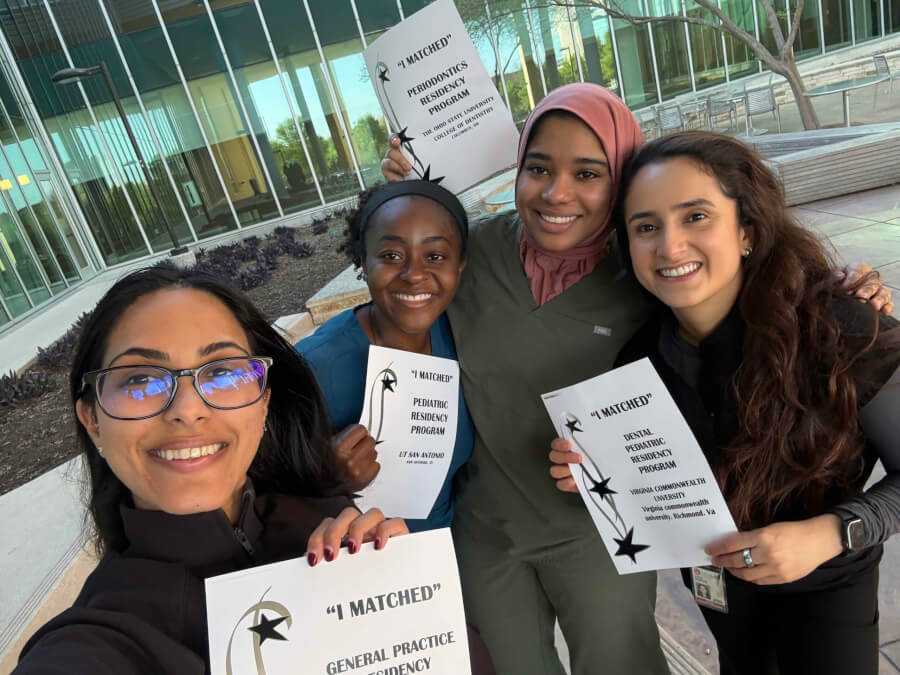
After commencement, Opoku-Ansah will remain at the School of Dentistry to begin a pediatric dentistry residency. According to her, the key to improving oral health outcomes starts early.
“A lot of adults who fear the dentist had bad experiences as children,” she said. “If you can make dentistry positive for kids, you change everything.”
She brings both skill and personality to that mission. She stays up to date on movies, TV shows, video games and social media trends, connecting with young patients through shared interests and creating an environment that feels safe and fun.
“I like to say I’m the cool auntie,” she said with a laugh.
Her goal as a provider is to build trust early, prevent problems before they begin and create a healthy ripple effect that extends across generations.
More than a degree
As she approaches graduation, Opoku-Ansah measures her success by moments of perseverance rather than by recounting academic milestones.
“I’m proud that I survived,” she said. “You look at the journey and wonder how you’ll make it. But you do.”
It is a statement grounded in resilience, the same resilience that carried her from a childhood dental visit to clinics in Ghana, lecture halls in London and patient care in San Antonio.
Her journey embodies the spirit of a new generation of health professionals who are globally trained, patient-centered and driven by purpose.
“My advice is to put yourself in the best position you can,” she said. “Do the work, and things will work out the way they’re supposed to.”