


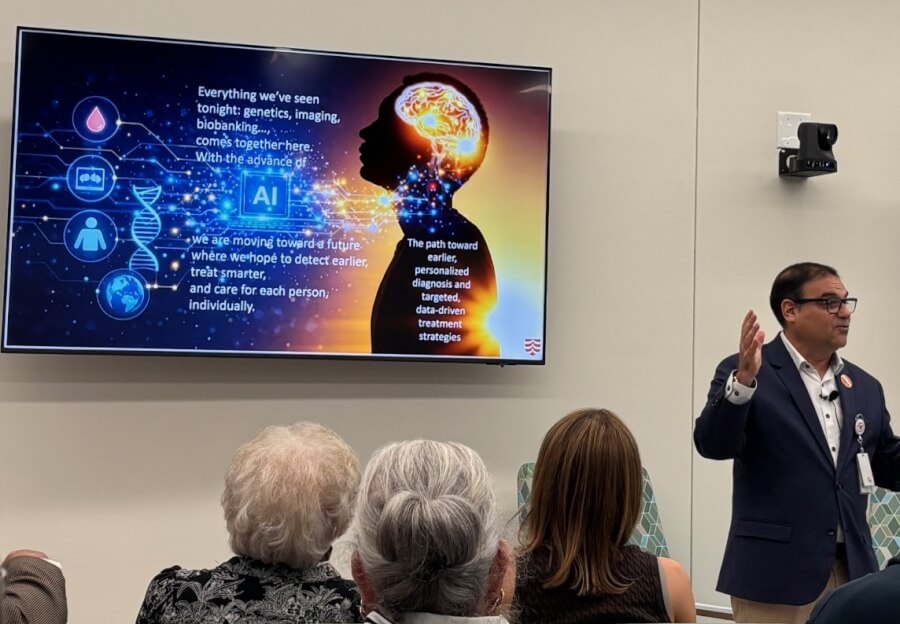
The BioFest Days brought the community together April 7, for an evening of discovery and connection at the UT Health San Antonio Center for Brain Health.
Hosted as part of the 12-day, citywide celebration of biomedical advancement organized by BioMed SA, the event invited attendees to explore how research, clinical care and community involvement are all crucial parts of the future of brain health.
Guests gathered in the Center for Brain Health’s community room to hear from internationally recognized scientists Sudha Seshadri, MD, DM, neurology professor and founding director of the Glenn Biggs Institute for Alzheimer’s and Neurodegenerative Diseases at UT Health San Antonio, the academic health campus of The University of Texas at San Antonio, and Agustín Ruiz, MD, PhD, biological core director with the Biggs Institute. Their presentations highlighted emerging breakthroughs in next-generation diagnostics and personalized approaches to care.
Changing landscape of dementia research
Seshadri offered a sweeping look at the rapidly evolving landscape of dementia research, including a growing pipeline of investigator-initiated clinical trials aimed at slowing — and ultimately halting — disease progression. She described how therapies originally developed for other conditions, including drugs that target aging pathways and antiviral treatments, are now being used in the research of Alzheimer’s disease and related disorders.
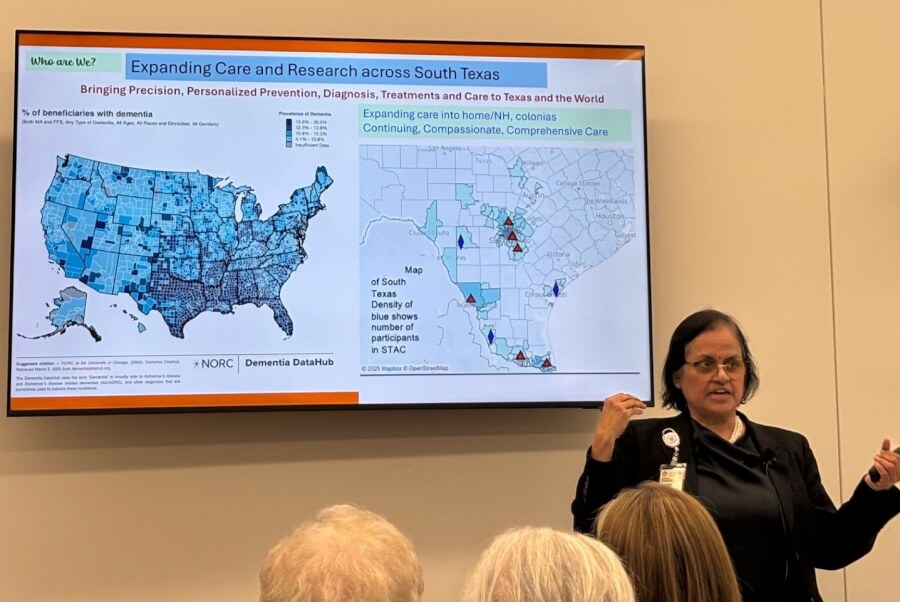
Seshadri emphasized that these advances reflect a shift toward earlier detection and more personalized, data-driven approaches to care, with research increasingly focused on understanding how many factors influence brain health over time.
“Breakthroughs in brain health will come from understanding the full picture — from genes, to environment and lived experience — and translating that knowledge into therapies that can truly change the course of disease,” Seshadri said. “We have made progress, but our goal is a future where we can not only delay dementia, but prevent or cure it altogether.”
Accelerating innovation with community support
Ruiz shared the global perspective that drew him to San Antonio after more than two decades leading research efforts in Spain, emphasizing the opportunity to help build a transformational center designed to accelerate discovery and improve care.
“I believe the future of this field will happen through what we are building right here,” Ruiz said. “We collect samples and data, but our goal is to convert that into knowledge and ultimately into better care. That only happens with the engagement of the community.”
Ruiz described how the Center’s growing biobank collects a wide range of biospecimens, including blood, saliva, spinal fluid and even skin samples, to unlock clues about the origins and progression of neurological disease. Combined with advanced imaging technologies such as the 7-Telsa MRI and PET scans, these efforts allow researchers to track changes in the brain over time and better understand how disease develops.
Brain bank a crucial resource
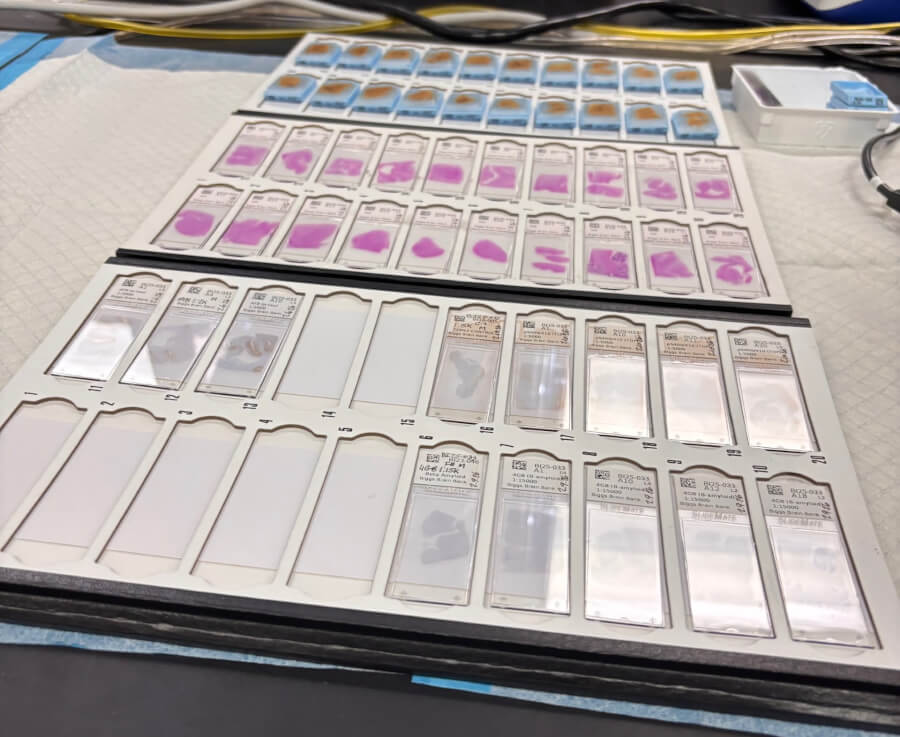
Equally critical is the UT Health San Antonio Brain Bank located at the South Texas Research Facility, where donated brains provide what Ruiz described as the “final picture” of disease. By studying brain tissue after death, researchers can validate findings observed in living patients and accelerate discoveries that would not otherwise be possible. These resources are preserved indefinitely and shared with scientists around the world, expanding their impact far beyond South Texas.
The importance of community participation was reinforced during the audience Q&A, when one attendee asked how to encourage more people, especially those without symptoms, to consider brain donation. Ruiz noted that while participation often comes from those directly affected by disease, broader public involvement is essential to building a more complete understanding of brain health.
The speakers emphasized agency in one’s own health, offering practical steps that individuals and their families can take to protect long-term brain health. They also highlighted the growing role of genomics, multi-omics, advanced imaging and artificial intelligence in transforming how neurological diseases are understood and treated.
“AI is going to be necessary and very important for understanding not only Alzheimer’s disease, but the whole of medicine and most of the diseases we are facing,” said Ruiz.
Center for compassionate care and discovery
Following the presentations, guests were invited to step into the spaces where innovation is actively unfolding. Guided tours of the Center for Brain Health offered a firsthand look at how compassionate care, research and cutting-edge technology are integrated to improve patient outcomes.
The evening concluded with an exclusive hands-on visit to the Brain Bank, where attendees saw how organ donation aids scientific discovery and advances understanding of complex neurological conditions.
By opening its doors to the community, the Center for Brain Health showcased its state-of-the-art facilities and role within the broader biomedical ecosystem which connects scientists, clinicians and the public. The event reflected a growing momentum in San Antonio, where collaboration is driving new pathways for discovery and healthcare.
Click here for more information about organ donation
Click here for more information about clinical trial at the Biggs Institute
Read more:
New Center for Brain Health pairs expert care with scientific discovery