


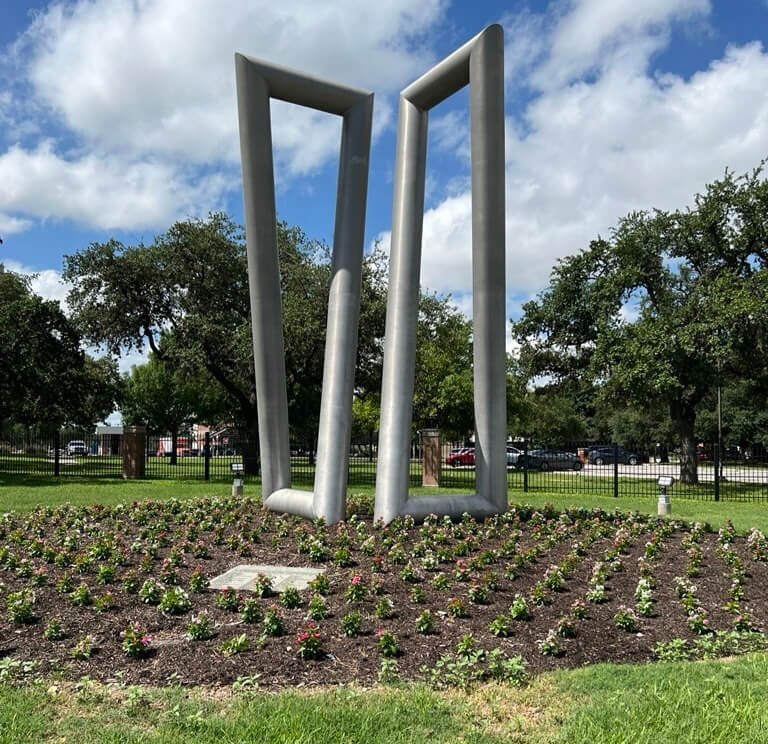
Near the main entrance of The University of Texas at San Antonio’s Health Science Center campus, a striking metallic “Double Helix” sculpture greets thousands of drivers each day as they make their way through the South Texas Medical Center — a metropolis of discovery, education, research and innovation.
Rising skyward, the angled aluminum sculpture was installed in 1981 at the nexus of Floyd Curl and Medical drives as a tribute to the visionaries who helped make the medical center possible. It also serves as a powerful symbol of scientific progress in motion, continuously advancing to provide a healthier, brighter future for San Antonio and beyond.
At the time, the Health Science Center was entering a period of strong growth — expanding its research programs, earning national recognition for its residency programs and deepening its commitment to community investment.
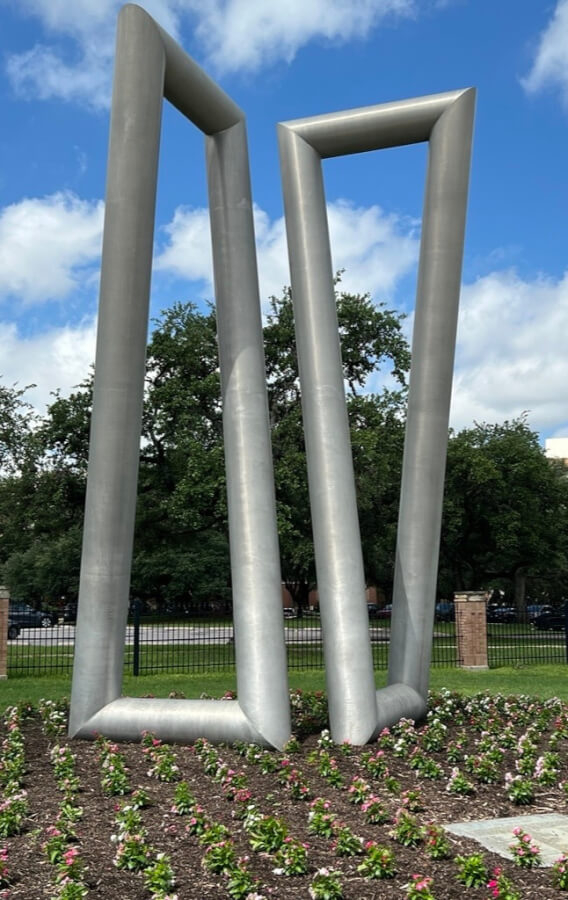 Today, UT San Antonio’s Health Science Center, much like the sculpture on its grounds, continues to advance a long-standing vision of progress, leading the education for the next generation of health professionals while strengthening a vital pipeline for the region’s healthcare workforce.
Sculpture pays tribute to the basis of all life
In May 1980, the San Antonio Medical Foundation commissioned local artist Richard Harrell Rogers to create a public sculpture to memorialize individuals and businesses that contributed at least $5,000 each in 1961 to purchase 436 acres for the South Texas Medical Center.
At the time, C.W. Miller, medical foundation trustee and chairman of the Founders Memorial Committee, hoped the artwork might encourage other organizations to include original art in their public spaces, he told The News, a publication of the Health Science Center.
“The sculpture is a very small token of gratitude for the South Texas Medical Center’s healthcare and economic impact on San Antonio,” he was quoted in the May 16, 1980, issue.
The concept for the sculpture reflected an idea Rogers had been developing for years. It would be based on the double helix of the DNA molecule, the basis of all life — fitting for a medical center that would have transformative potential to improve lives.
“I have long been interested in the possibility of using the double helix as a sculptural concept, not just to illuminate it, but to abstract it and create a logical progression of forms that will symbolize the DNA molecule, and at the same time, exist as a public work of art with its own internal order and sense of mystery,” said Rogers in a San Antonio Express-News article published May 11, 1980.
The sculpture would be constructed from aluminum cylinders, 20 feet long and 30 inches in diameter.
Rogers enlisted the help of San Antonio commercial kitchen installation firm Krus-Forestier Corp. to shape, cut and weld gigantic pieces of aluminum sheets into cylinders.
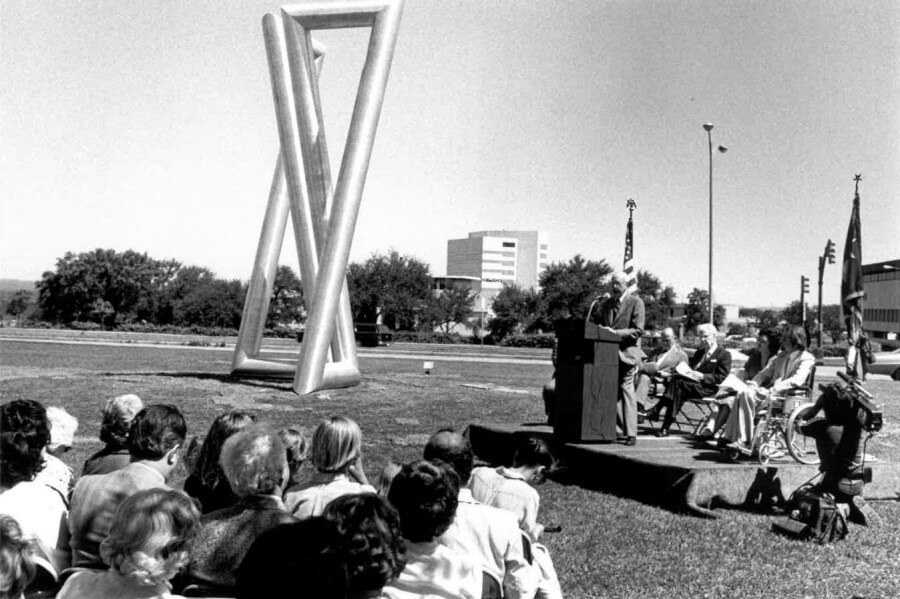
After the aluminum cylinders for the sculpture were welded and buffed, the structure would be installed on an eight-foot-deep concrete foundation with huge metallic poles fitted into ‘sleeves’ built onto the sculpture, according to the San Antonio Light, published Jan. 27, 1981.
In May 1981, the “Double Helix” was officially dedicated on the Health Science Center grounds in a ceremony attended by Gov. William P. Clements Jr.’s wife, Rita Clements, then-Health Science Center President Frank Harrison, MD, and other local dignitaries, including members of the San Antonio Medical Foundation.
A legacy of impact
Akin to the vision of great scientific impact for the medical center, the artist behind the “Double Helix” sculpture also made a strong impact through his art and his perseverance.
After a car accident left Rogers paralyzed from the waist down at 15, the teen’s doctors didn’t expect him to make it past his 20th birthday, according to an article by the Bengal Lancer Alumni Foundation, a charitable organization of the Bengal Lancer Fraternity at Trinity University.
But Rogers defied the odds. After a year of rehabilitation, he was set on returning to Jefferson High School, where his classmates helped him get around, lifting his wheelchair up and down stairs, according to the foundation’s website.
During his senior year in high school, Rogers was elected class president and named “Outstanding Young Man of San Antonio” by the San Antonio Express-News.
He later attended Trinity University, The University of Texas at Austin and the San Antonio Art Institute.
Rogers would go on to create artwork featured across the country, including the Smithsonian’s Air and Space Museum in Washington, D.C., the Woodlands in Houston, Parkway Presbyterian Church in Corpus Christi and other prominent locations.
During the last 20 years of his life, the artist invented better designs for wheelchairs with his son, ultimately creating a business that would become Adorno-Rogers Technology. On Nov. 8, 2012, Rogers died at age 71.
In an interview with the San Antonio Light, Rogers said he hoped that those who saw his work would feel “something.” He understood that the impact of his creation lay in what it stirred in others.
Decades after its installation, the timeless “Double Helix” sculpture continues to have enduring impact, symbolizing hope, healing and progress to help improve lives.
Editor’s note: Archived articles for The News (a publication of the Health Science Center), San Antonio Express-News and San Antonio Light, were provided by the P. I. Nixon Medical Historical Library – University Archives at UT San Antonio’s Health Science Center. Pat Ireland Nixon, MD, was the founder of the Bexar County Medical Library Association in 1919. His efforts helped the Bexar County Medical Library accumulate a large collection of historical medical books, some of which were later donated to the Health Science Center.