


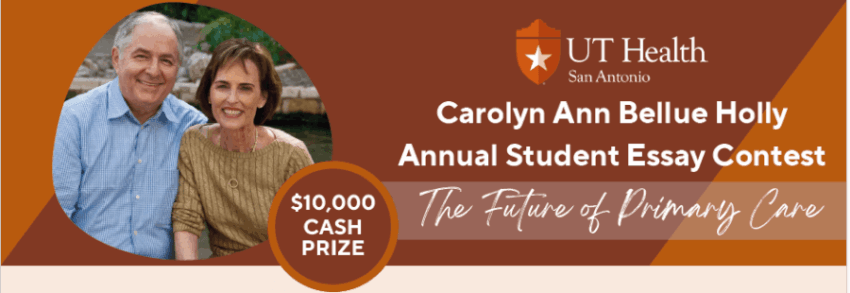
Three medical students from the Joe R. and Teresa Lozano Long School of Medicine were named winners of the 2nd annual Carolyn Ann Bellue Holly Annual Student Essay Contest during Primary Care Week Oct. 6–8.
The contest winners — Daniel Bellingham, Anisha Oommen and Tommy Torres — will each receive $10,000 in the coming months and those matching with a family medicine residency program will receive an additional $5,000 gift during their final year of medical training.
The contest winners were chosen from four finalists who participated in a virtual panel discussion to answer questions about their essays. Runner-up Cadfael Soulard, a fourth-year medical student, will receive $5,000 in the coming months.
Promising visions for patient-centered care
As part of their contest submissions, each of the finalists provided their visions for a patient-centered future for primary care. The entries included abstracts and essays citing sources from a digital archive reflecting on the career of James L. Holly, MD, distinguished alumnus of the Long School of Medicine.
Holly, a primary care innovator who built the world-renowned Southeast Texas Medical Associates (SETMA), LLP, created the essay contest to honor the memory and enduring legacy of his beloved wife of 57 years, Carolyn Ann Bellue Holly.
Torres, a fourth-year medical student, envisioned a future in which social workers are core members of the primary care team. “My clinical experience has shown that the greatest barriers to health are often social in nature: homelessness, addiction, poverty, limited access to care and lack of support systems.
“Together, we can prioritize psychosocial care plans alongside medical treatment, ensuring care is accessible, affordable and aligned with patients’ goals and circumstances,” he stated.
The winnings will provide Torres a chance to give back to those who helped him along his educational journey.
“From my single mom who gave her boys everything, to my supportive fiancé who’s been by my side through it all, this is the first step toward paying off my loans,” Torres said. “My hope is that sooner rather than later, I can pay it forward to my family and to the communities that made me who I am today.”
Health equity was an important part of Bellingham’s future vision for primary care.
“My experiences in underserved communities, both in the U.S. and abroad, have shown me how urgently we need more accessible care,” the third-year medical student stated in his abstract. “I propose mobile clinics, school-based health education and regional hubs that bring patients, providers and community leaders together through telehealth solutions.”
Bellingham plans to use the prize money to help fund his education.
“As an out-of-state student and father of two, I’m faced with additional expenses that other students may not encounter,” he said. “This scholarship will help ease my financial burden and give me opportunity to allocate my capital, time and attention to other endeavors.”
Anisha Oommen’s vision for primary care “lies in the shift toward personalized medicine, which emphasizes tailoring treatments to an individual’s unique biological and clinical characteristics.” Emerging technologies will ultimately play a significant role in healthcare, the second-year medical student added.
“Clinical centers can pave the way for change by having processes in place to adopt new technologies and to provide training to care teams on how to best interact with computational tools,” Oommen stated. “Policymakers will also need to work to prepare the medical industry for appropriately incorporating these tools.”
Oommen said she appreciates the opportunity the scholarship provides and plans to allocate the prize funds toward her tuition expenses.
In his essay, Soulard drew an intricate tapestry of parallels between the guiding lines on crosswalks and hospital floors and those that reach beyond the hospital walls into communities, people’s homes and their lives.
“I see lines that connect providers and patients in partnerships built on trust, lines that leverage technology without losing the human touch and lines that intersect to address disparities and promote health equity,” he stated, adding that he is committed to creating a future “that empowers patients, leverages technology responsibly and fosters a culture of trust and equity.
“Ultimately, the lines of a crosswalk are not boundaries; they are bridges. And it is our responsibility to ensure that every person who walks them does so with hope, dignity and the assurance that they are never alone,” Soulard said.
Contest details
The 19 entrants who participated in the essay contest were asked to review the content of Holly’s 66,000-page digital archive and reflect on his career and how SETMA changed the course and future of medicine.
The four finalists were selected by a panel of judges including Sue Bornstein, MD, 2025 Bellue Holly Distinguished visiting professor; Alexis J. Ramos, MD, clinical assistant professor, Department of Family and Community Medicine; Yun Shi, MD, clinical assistant professor, Department of Family and Community Medicine; and Ryan Menchaca, MD, clinical assistant professor, Department of Family and Community Medicine.
During a virtual panel discussion on Monday, Oct. 6, the finalists answered questions about their essays and described what they learned from Holly’s digital archive. The judges ranked the finalists’ responses, and the rankings were reviewed and totaled to determine the top three entrants and the runner-up.
The cash prizes for each of the winners will come from an established endowment from Holly.
2026 essay contest
The 2026 Carolyn Ann Bellue Holly Annual Student Essay Contest will begin Oct. 15 and run through Wednesday, Dec. 31. Learn more.
View the finalists’ abstracts and essays below.
Winners:
Daniel Bellingham: Abstract and essay
Tommy Torres: Abstract and essay
Runner-up:
Cadfael Soulard: Abstract and essay