


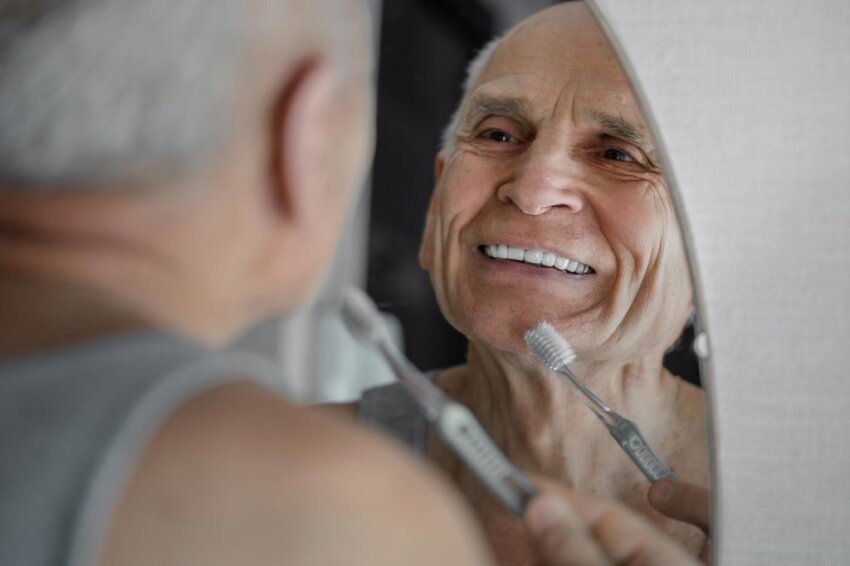
Imagine for a moment that one day, a loved one picks up their toothbrush, turns it in their hands and pauses. Something once so automatic suddenly unsettles them.
For many families caring for someone with dementia, these small moments of quiet hesitation at the bathroom sink are among the first signs that oral care is becoming unfamiliar.

And those changes matter more than most people realize.
Across the country, families caring for loved ones with dementia notice similar shifts: a reluctance to brush, hesitation at mealtimes, withdrawal from social spaces. These changes often point to the deeper and little-discussed truth that oral health and brain health are closely intertwined and neglecting one can accelerate decline in the other.
School of Dentistry prosthodontist and Interim Director of the Geriatric Dentistry Clinic Vinaya Kundapur, BDS, MDS, FICD, sees this relationship every day. Trained in geriatric and special needs dentistry, she has treated thousands of older adults in clinics, nursing homes and dental mobile units. Her consistent message over the years has been that oral health is not cosmetic. It is cognitive, emotional and profoundly tied to quality of life.
Tooth loss and memory loss intersect
Families are often surprised to learn how strongly oral health predicts cognitive changes, Kundapur said. Bacteria associated with gum disease have been found in the brains of Alzheimer’s patients, and studies show that having fewer than six teeth significantly increases the risk of dementia.
 “It’s not just tooth loss. It’s the loss of chewing ability that impacts risk,” Kundapur explained. “Chewing stimulates the brain. When that’s diminished, cognition can decline more quickly.”
But just as important are the social and emotional consequences. Kundapur frequently sees nursing home residents withdraw from communal dining when they struggle to chew or feel embarrassed about missing teeth. That isolation deepens anxiety and depression, two conditions known to worsen behavioral symptoms of dementia.
“It starts with something as simple as eating slower,” she said. “Then suddenly they stop joining others altogether.”
Another serious risk is aspiration pneumonia, one of the leading causes of death among nursing home residents, according to Kundapur. “The mouth is the gateway,” she said. “If oral hygiene is poor, bacteria can enter the airway and cause a life-threatening infection.”
When dementia disrupts daily care
Dementia affects oral care long before it’s identified at a dental appointment. In moderate stages, patients may no longer recognize a toothbrush, or they may confuse it with a hairbrush. Motor symptoms such as tremors can make brushing physically difficult. Many commonly prescribed medications often cause dry mouth as a side effect, which dramatically increases the risk of cavities and infections.
In earlier eras, some clinicians recommended extracting teeth in advanced dementia patients to simplify care, Kundapur shared. Today, she said that the recommendation is for preserving teeth and chewing ability for as long as possible. Tooth preservation supports cognitive health, nutrition and overall physical health, which Kundapur said increases quality of life.
“Now knowing that tooth loss and cognitive loss are connected, maintaining the ability to chew is essential,” she said.
What caregivers should know
Caregivers often suspect a loved one is refusing care intentionally, but Kundapur explained the reality is far more tender. A person with dementia may simply not understand the purpose of the toothbrush or may feel overwhelmed by sensory input. “It’s confusion more than defiance,” she said.
 She encouraged caregivers to think about moments of forgetfulness in their own lives such as opening the refrigerator and forgetting why, a phenomenon known as the doorway effect. “That one moment frustrates us,” she said. “Now imagine living in that feeling all day.”
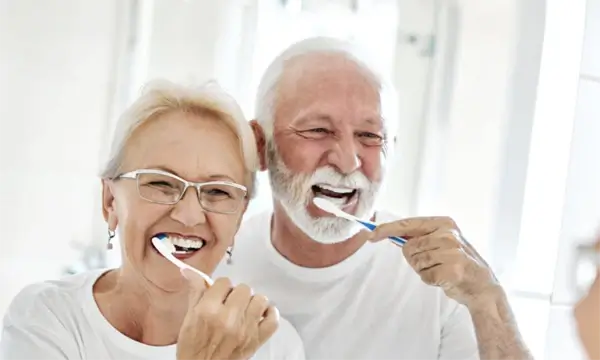
Because of this, she urges families to approach oral care with patience and creativity. Some patients tolerate brushing better later in the day, when their mood is calmer. Others benefit from side-by-side brushing, where the caregiver demonstrates instead of taking over. Familiar routines, consistent tools, slow movements and gentle verbal cues can all make the difference between fear and cooperation, Kundapur said.
Dry mouth in older adults is another silent challenge. Without saliva’s natural cleansing ability, food particles and bacteria linger, accelerating tooth decay. “Brushing can’t be optional,” Kundapur said. “It’s essential — not only for comfort but for preventing infections that can lead to hospitalization.”
Above all, Kundapur wants caregivers to know they are not alone. “Our elders once created a world for us,” she said. “We are here to help families.”
A final message for families
Dementia may alter memory and behavior, but it does not erase a person’s dignity, Kundapur said. Oral health is one of the most immediate, tangible ways caregivers can preserve comfort and quality of life.
“Losing memory is the hardest thing,” she said. “Yet caring for the mouth — something so fundamental — helps protect dignity and identity. Caring for our older adults is an honor and a responsibility we deeply value.”
For information about UT Dentistry’s Geriatric Dentistry Clinic, visit their website or call 210-450-3290.